Actium: The Battle That Made the Empire
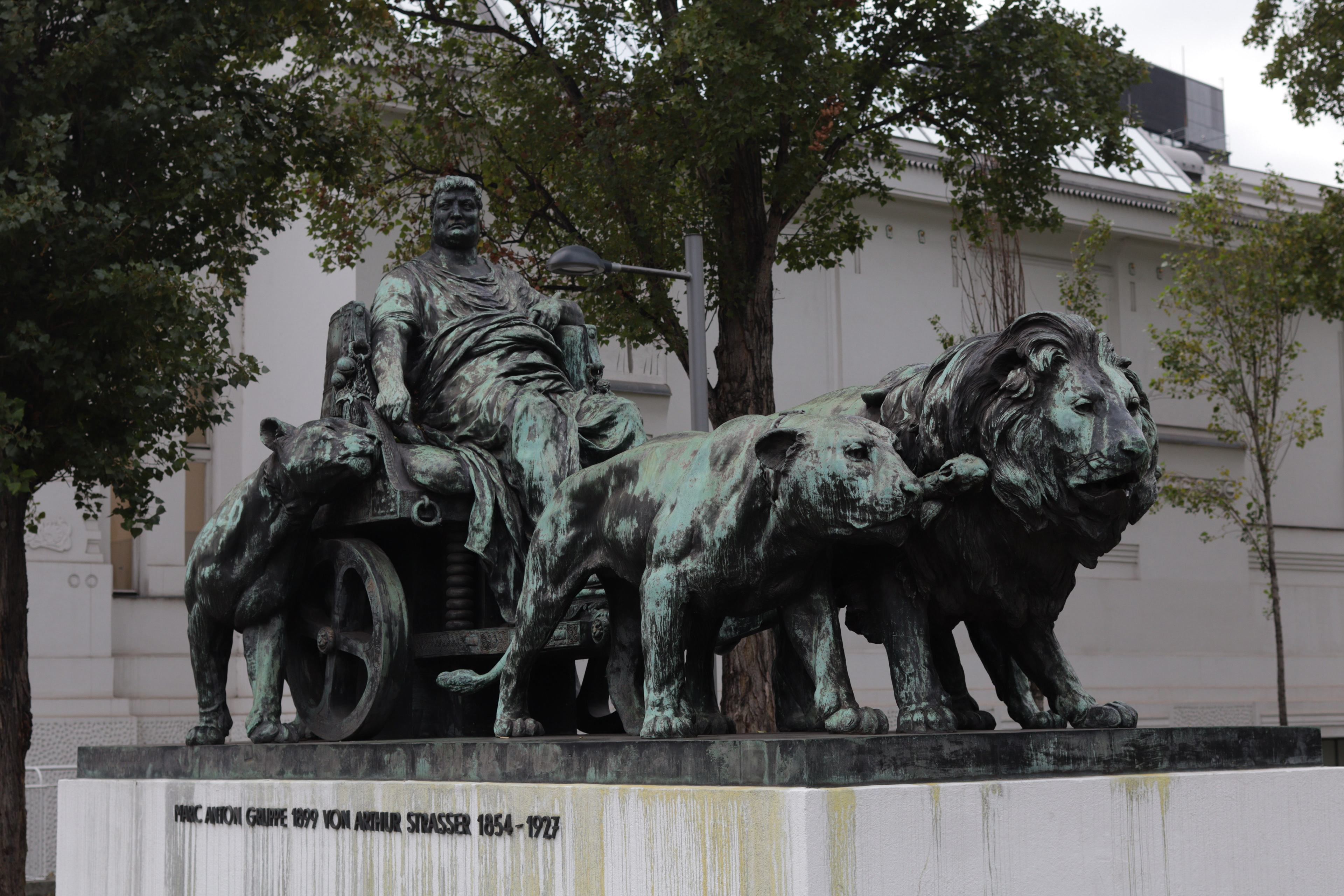
Outside the Vienna Secession building stands one of the more theatrical bronze monuments in Europe: the Marc Anton Gruppe, cast in 1899 by the Austrian sculptor Arthur Strasser. It shows Mark Antony in full Roman dress, seated in a chariot pulled not by horses but by four lions — two fully grown, two younger, all rendered with remarkable musculature and a controlled ferocity that has not softened in 125 years of Viennese weather. The patina has gone deep green. The lions look ready to move. Antony sits above them with the bearing of a man accustomed to commanding things that could kill him.
Strasser was not aiming for historical accuracy and did not need to be. The lion-drawn chariot is a Dionysian image — the god of wine and transformation rode lions or leopards, and Antony, who styled himself the New Dionysus in the eastern provinces he controlled, would have recognized the reference immediately. What Strasser captured is something the historical sources also convey: Mark Antony as a figure of overwhelming physical and political presence, a man whose charisma was inseparable from his danger, whose appeal was real enough to hold the eastern empire together for a decade and to captivate the most politically capable woman of the ancient world. The monument is romantic in the nineteenth-century sense — grand, slightly excessive, not entirely tamed — and that is precisely right for its subject.
The Battle of Actium on September 2, 31 BC was not a particularly impressive naval engagement by the standards of ancient warfare. It was not especially close, not especially bloody, and not decided by brilliant tactics or unusual courage. What it was, was decisive in the way that very few battles actually are: it determined who would rule the Roman world for the next five centuries and set the conditions for everything that followed. Octavian defeated Mark Antony and Cleopatra at Actium, and Rome became an empire.
The battle was the culmination of a decade of maneuvering that had begun with Caesar’s assassination. The Second Triumvirate — Octavian, Antony, and Lepidus — had divided the Roman world among themselves and then proceeded to eliminate each other. Lepidus was forced into retirement by Octavian in 36 BC. Antony and Octavian had maintained an increasingly strained alliance, stabilized briefly by Antony’s politically convenient marriage to Octavian’s sister Octavia, and sustained by the practical reality that neither was yet strong enough to destroy the other.
The rupture was made official when Antony divorced Octavia in 32 BC and formalized his relationship with Cleopatra, with whom he had three children. Octavian used this aggressively. He obtained and publicly read Antony’s will — illegally seized from the Vestal Virgins who held it in custody — which reportedly left Roman territories to Cleopatra’s children and requested burial in Alexandria rather than Rome. Whether the will’s contents were accurate or fabricated, the political effect was the same: Octavian could now present the coming war not as a Roman civil conflict but as a patriotic defense against a foreign queen who had enchanted a Roman general into betraying his country. The Senate stripped Antony of his powers and declared war on Cleopatra.
Both sides assembled their forces in Greece in the summer of 31 BC. Antony and Cleopatra camped at Actium on the western coast, their fleet of roughly five hundred ships blockaded in the Ambracian Gulf by Octavian’s admiral Marcus Agrippa. The blockade was effective. Antony’s forces suffered from disease, desertion, and supply shortages over the summer months. By September, the position was untenable. Antony and Cleopatra decided to break out with their fleet and retreat to Egypt.
What happened next is disputed by ancient sources and remains contested. The breakout attempt turned into a battle as Agrippa’s ships moved to intercept. Antony’s left wing struggled and his center came under pressure. Cleopatra’s squadron, holding the center-rear with Antony’s treasury and their escape route, raised sails — which the ancient sources interpret variously as cowardice, a prearranged signal, or a logical response to deteriorating conditions — and broke through the line toward the open sea. Antony followed. The remainder of his fleet, lacking clear command, eventually surrendered or was destroyed.
The casualties at Actium were modest by the standards of the civil wars. The strategic consequences were not. Antony and Cleopatra reached Egypt, but their cause was finished. Their forces in Greece surrendered to Octavian over the following weeks. Egypt had no realistic prospect of military resistance. When Octavian arrived in Alexandria in August of 30 BC, Antony killed himself on the false report that Cleopatra was already dead. Cleopatra, after reportedly attempting to negotiate terms with Octavian and concluding that the terms would include being displayed in a Roman triumph, killed herself by means that ancient sources describe as snakebite and modern scholars debate. Egypt became a Roman province.
Strasser’s monument was unveiled the same year as the Secession building it faces — 1898, though the sculpture itself is dated 1899 — at the height of Viennese cultural ambition, when the city was producing Klimt, Mahler, Freud, and Wittgenstein within a few square kilometers of each other. The choice of Antony as subject was not accidental. The Secession movement was about the collision of individual genius with institutional constraint, of sensuality with established order, of the overwhelming personality with the system that cannot contain it. Antony fit. He was the man who had everything Rome could offer — military genius, political standing, personal charisma — and who lost it all to a combination of his own nature and the colder calculations of a younger man who understood that winning required not being Antony.
Octavian returned to Rome to begin the slow process of converting his military supremacy into constitutional authority. The settlement of 27 BC — which produced the title Augustus and the legal framework of the principate — was the political architecture built on the military foundation of Actium. Actium made Augustus possible. Augustus made the Empire.
The battle has attracted less attention than its consequences deserve, perhaps because it was not a close thing and not particularly dramatic in its execution. But the contingency matters. A different outcome at Actium — Antony consolidating control of the eastern empire and Egypt, fighting a prolonged war against Octavian from an unassailable resource base — would have produced a different Roman world. The principate, the Pax Augusta, the particular form the Empire took: all of it was downstream of an engagement that lasted a few hours on a September morning off the Greek coast.
Strasser’s Antony sits above his lions in permanent bronze stillness, going nowhere, which is the monument’s unintended irony. The historical Antony was always moving — across the Mediterranean, between alliances, between worlds — and the stillness that found him at the end was not bronze but the stillness of a man who had run out of room. The lions wait. The chariot does not move. Vienna walks past it every day.