Roman Naval Warfare: The Sea They Called Their Own
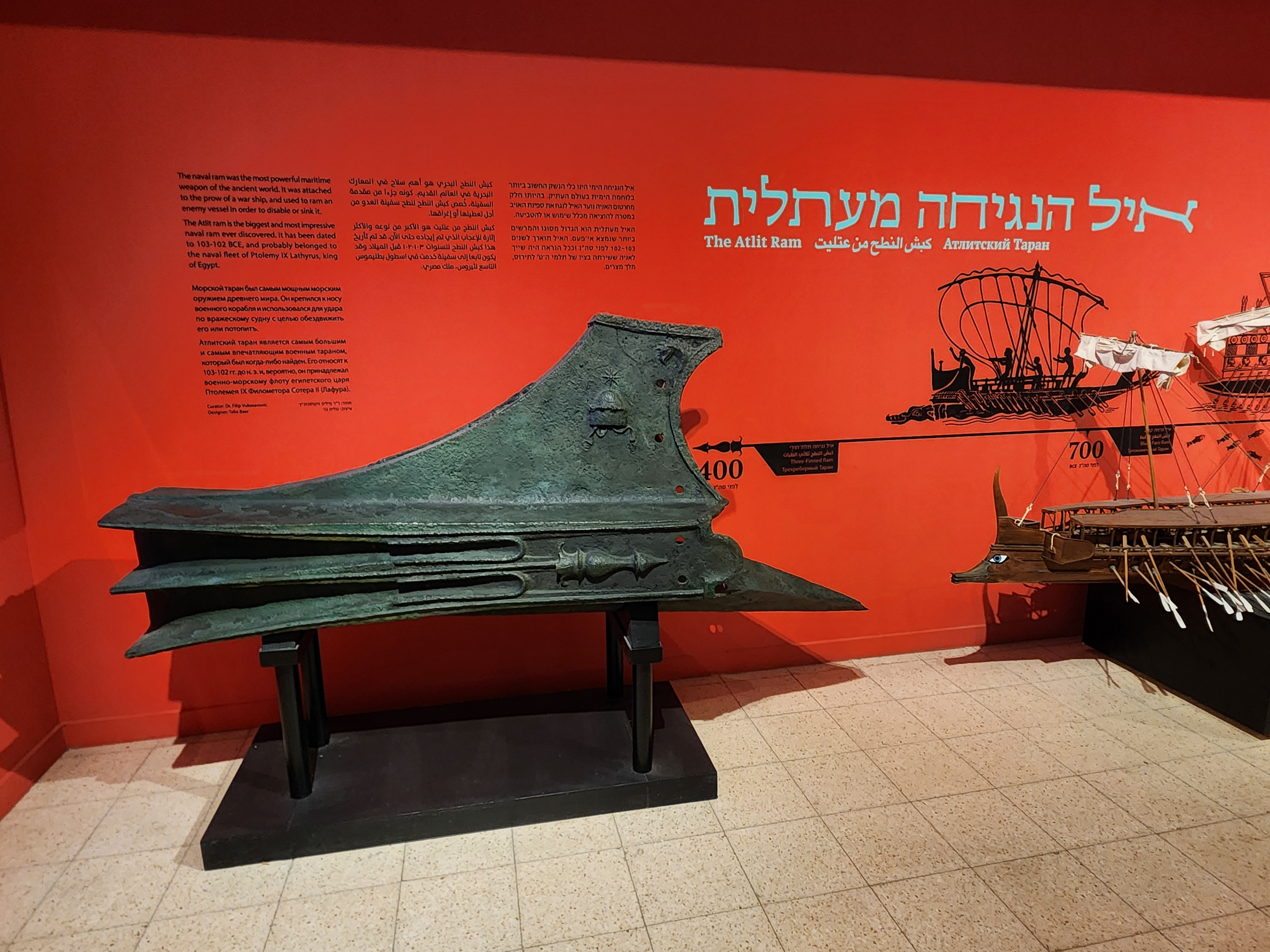
In the National Maritime Museum in Haifa, mounted on a low plinth against a red wall, sits the most significant surviving object from ancient naval warfare: the Atlit Ram, a bronze naval ram recovered by divers off the Israeli coast in 1980, dated to approximately 103–102 BCE, and identified on the basis of its construction and the coins found within it as probably belonging to the fleet of Ptolemy IX Soter II of Egypt. It is roughly 2.3 meters long and weighs over 465 kilograms. It is the only complete ancient naval ram in existence, and looking at it — the three horizontal blades converging at the forward point, the decorated upper surface with its trident and eagle motifs, the massive bronze casting that absorbed decades of seawater and still holds its shape — makes abstract discussions of ancient naval warfare immediately concrete. This is the weapon. Everything else is description.
The ram was the defining technology of ancient Mediterranean naval warfare from the fifth century BC through the Roman imperial period, and Rome neither invented it nor initially understood how to use it. When Rome first confronted Carthage at sea in the First Punic War beginning in 264 BC, the Romans had essentially no naval tradition and were facing a Carthaginian fleet that had dominated the western Mediterranean for generations. The solution Rome found — building a fleet from scratch, developing the corvus boarding bridge to convert naval engagements into infantry fights — was pragmatic and effective and reflected a land power’s instinct to reduce the sea to a surface on which ground combat could occur. The ram was someone else’s technology, inherited from the Greek tradition that had perfected it at Salamis and Aegospotami, transmitted through the Hellenistic navies of which the Atlit Ram’s ship was a representative. Rome learned it the hard way.
Rome called the Mediterranean mare nostrum — our sea — with a proprietorial confidence that would have seemed absurd in the third century BC, when Rome barely had a navy and Carthage’s fleet controlled the western Mediterranean. That the claim became factually accurate within a century and remained so for four more is one of the more striking strategic transformations in ancient history: a land power with no maritime tradition built a navy, fought the greatest naval power of the ancient world, and eventually achieved a dominance over the Mediterranean so complete that it had eliminated piracy, secured trade routes, and reduced naval competition to the point where maintaining a large battle fleet was unnecessary. Rome conquered the sea the same way it conquered everything else — not through inherent advantage but through organizational capacity and willingness to pay whatever the victory cost.
The ram worked through physics that the Atlit example makes visually immediate. An oared warship — a trireme or its heavier successors, the quadrireme and quinquereme — was designed to accelerate to ramming speed, typically eight to ten knots, and drive the bronze-sheathed ram below the waterline into the hull of an enemy vessel. The three horizontal blades of the Atlit Ram’s design distributed the impact across a wider surface area than a single point ram while maintaining the penetrating force necessary to breach a wooden hull. The ship’s own momentum did the work; the ram was the shaped instrument that directed that momentum into structural damage. A successful ramming strike holed the enemy ship below the waterline and filled it with water faster than the crew could respond. An unsuccessful one — a glancing blow, or a ram that stuck in the enemy hull and dragged the attacking ship down with the sinking target — was catastrophic for the attacker. The maneuver required precise seamanship, good intelligence about the enemy’s position, and the training to execute a high-speed approach and withdrawal without fouling oars or losing way.
The First Punic War forced the issue. Rome’s conflict with Carthage over Sicily beginning in 264 BC could not be resolved without naval power, because Carthage’s control of the sea allowed it to supply and reinforce its Sicilian positions in ways that Roman land forces could not interdict. Roman tradition claims that the first Roman warship was built by copying a Carthaginian quinquireme that had run aground — the engineers literally used it as a template — which may be apocryphal but captures something real about the speed and improvisation of Rome’s naval buildup. The corvus — the boarding bridge that allowed Roman soldiers to fight ship-to-ship engagements as if they were land battles — was the tactical innovation that gave Rome an initial advantage by converting naval combat from a contest of seamanship to a contest of infantry, the latter being Rome’s specialty.
The Roman victories at Mylae in 260 BC and the Aegates Islands in 241 BC — the latter ending the First Punic War — demonstrated that a power with no maritime tradition could achieve naval dominance within a generation through organizational effort and tactical adaptation. The corvus was eventually abandoned, probably because it made ships top-heavy and dangerously unstable in rough weather — Rome lost several fleets to storms rather than enemy action during the First Punic War, suggesting that seamanship remained a weakness. But the core lesson was retained: Roman infantry discipline and organizational capacity could compensate for maritime inexperience if the tactical situation could be arranged to favor close combat.
The fleet’s role during the Principate shifted from offensive warfare to police functions. The elimination of Sextus Pompey’s piracy in the 30s BC by Octavian’s admiral Agrippa at the Battle of Naulochus in 36 BC — a genuinely complex naval engagement fought in the waters around Sicily — was the last major naval battle within the Mediterranean for several generations. What followed was a Mediterranean essentially at peace: the Classis Misenensis, based at Misenum on the Bay of Naples, and the Classis Ravennatis, based at Ravenna on the Adriatic, were the two main Italian fleets, their primary functions transport, communication, anti-piracy patrol, and the supply of grain convoys rather than fleet-to-fleet combat.
The fall of the Western Empire produced a Mediterranean no longer under unified Roman control, which created the conditions for its progressive domination by Vandal naval forces operating from their North African base. The Vandal sack of Rome in 455 AD was accomplished via a fleet that sailed from Carthage unmolested — a reversal of the Punic War strategic logic so complete that it would have been incomprehensible to the Romans who had fought so hard to ensure it could never happen. Mare nostrum had ceased to be ours.
The Atlit Ram sits in Haifa having outlasted every fleet that used weapons like it. The ship it was mounted on sank somewhere off the Israeli coast in the last century BC, probably in a storm rather than a battle — no signs of combat damage were found with it. The crew drowned or swam. The wood rotted. The bronze endured, as bronze does, lying on the seabed for two thousand years until a diver found it. The weapon that decided ancient naval battles is now a museum object in a country that did not exist when it was cast, in a sea that Rome once called its own and which has since passed through the hands of Byzantines, Arabs, Crusaders, Ottomans, and the navies of the modern world. The ram does not record any of this. It simply persists, which is what bronze does, and what the sea eventually allows.