Roman Superstitions: The Fears of a Practical People
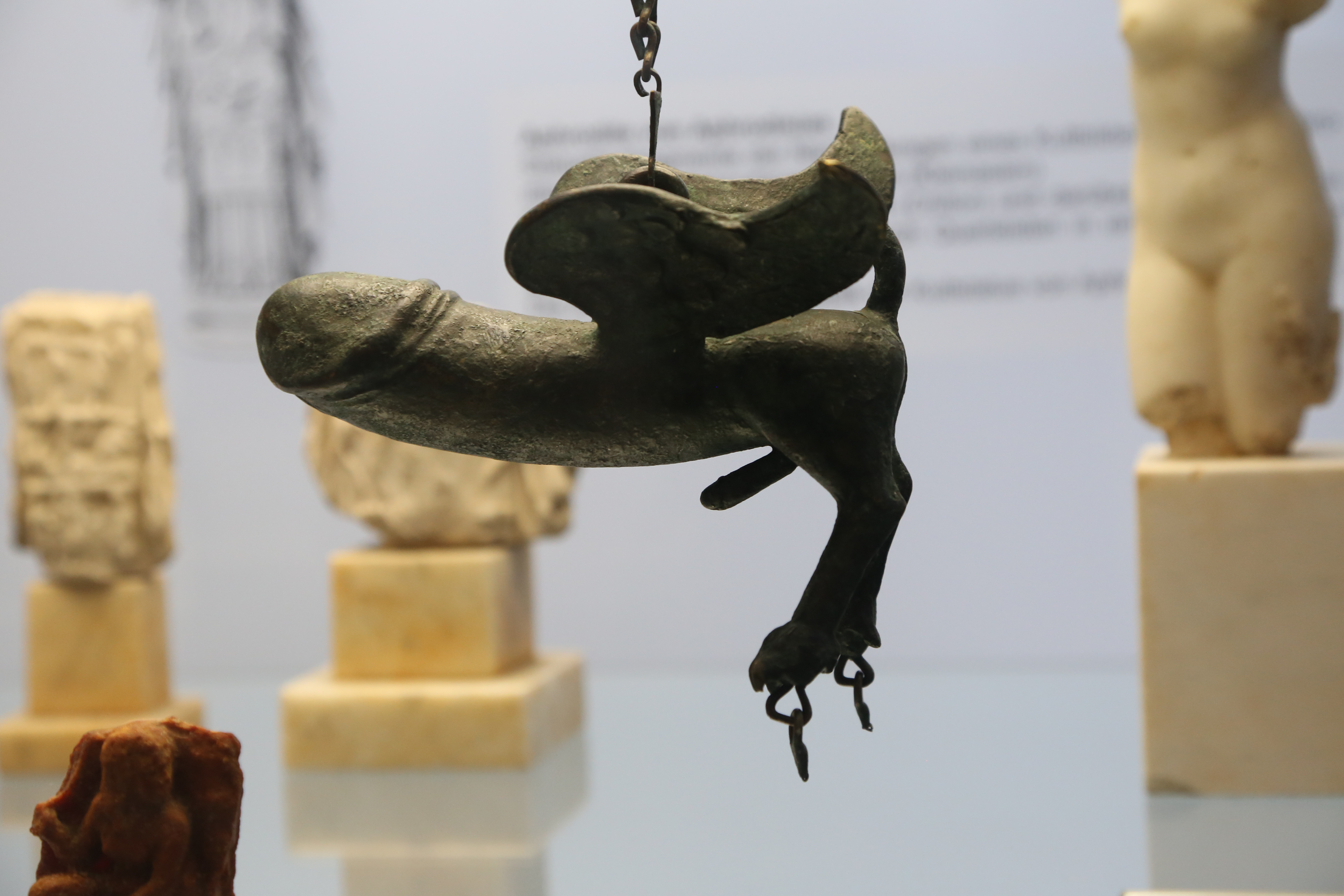
It hangs from a chain in a museum case in Hannover, small and bronze and entirely matter-of-fact about what it is. A winged phallus with bird legs, the feet fitted with tiny rings that once held bells. The wings spread to either side. The whole object was designed to move — to hang in a doorway or above a cradle, to swing in a draft, to catch the light and ring softly when the air shifted. This is a fascinum, the primary Roman protective object against the evil eye, and it was as ordinary a household item in imperial Rome as a smoke detector is today: unremarkable in its presence, urgently necessary in its function, noticed only when it was absent.
The evil eye — the fascinum in its malevolent sense, the same word covering both threat and protection — was among the most universally feared supernatural dangers in Roman culture, and the fascinum amulet was the standard countermeasure. The belief was precise: a malicious or envious glance could harm, wither, or kill. Children were most vulnerable, followed by brides, new animals, recently completed buildings, and anyone whose conspicuous success might attract the envy of someone with the capacity to damage it. The amulet’s design was not arbitrary. The phallus invoked generative power against destruction. The wings suggested divine protection and the speed to outrun harm. The bells — whose rings have long since been lost from the Hannover example — provided sound to disperse malevolent forces before they could settle. Every element worked.
The Romans were simultaneously the most practically minded people in the ancient world and among the most superstitious. This is not a contradiction. Superstition — the belief that specific acts, objects, words, and encounters have causal effects on outcomes beyond what rational analysis can explain — tends to flourish precisely among people who need reliable outcomes and who have incomplete knowledge of the mechanisms that produce them. The Romans needed reliable harvests, reliable military victories, reliable births, and reliable business outcomes. Their practical knowledge of how to achieve these things was considerable but not complete. The gap between what they knew and what they needed to know was filled by omens, amulets, spells, and the accumulated lore of good luck and bad luck that constituted Roman superstition.
The fascinum appeared everywhere the Romans felt vulnerability required protection. They hung in doorways, above the entrances to workshops and bakeries, at the thresholds of private homes. Small versions were worn around children’s necks as pendants — the bulla, the gold locket that protected Roman boys until they assumed the toga virilis at adolescence, often contained apotropaic materials alongside its fascinum function. Larger versions were mounted on the front of military vehicles: the Roman triumph included a fascinum suspended beneath the chariot of the conquering general, a priest whispering protective incantations behind him as the crowd’s acclaim reached its most dangerous pitch. In Roman thinking, the moment of greatest success was precisely the moment of greatest vulnerability to the envious gaze.
The calendar was organized around days that were auspicious or inauspicious for specific activities. Dies nefasti — inauspicious days — were not appropriate for conducting legal business, assemblies, or military actions; dies fasti were legally open; dies comitiales were suitable for popular assemblies. The calendar’s annotation of days by religious and legal character was maintained by the pontiffs and reflected centuries of accumulated superstitious lore about which dates had been associated with disaster or success. The dies ater — black days — were the anniversaries of military catastrophes: the Allia, where the Romans had been defeated by the Gauls in 390 BC, was such a day, and military actions on that date were avoided. The superstition that linked a date to its worst historical association was a form of risk management that acknowledged the limits of rational planning.
Sneezing was a powerful omen whose direction of interpretation varied by context. A sneeze at the beginning of an action could be a good sign or a bad one depending on circumstances; a sneeze when getting up from a chair was generally considered auspicious. The Latin word for sneezing — sternutamentum — was the subject of an enormous accumulation of interpretive lore that Pliny the Elder preserves in his Natural History alongside mining techniques and agricultural advice, because for Pliny the boundary between scientific knowledge and superstitious lore was not where modern readers draw it.
The crossroads was a point of supernatural power and danger. Hecate, the goddess of the crossroads, received offerings at intersections; ghosts and malevolent spirits were associated with crossroads; magic was performed there, and objects used in magical operations were deposited there. The Compitalia — the festival of the crossroads — was one of the most widely celebrated in Rome, organized at the neighborhood level around the shrines that marked the neighborhood boundaries. The superstition attached to crossroads reflects a broader Roman tendency to identify liminal spaces — thresholds, doorways, river crossings, points between one state and another — as sites of supernatural activity requiring ritual attention.
Luck animals and luck objects accumulated their significance through long cultural tradition. The weasel, if seen on the left, was unlucky; hares, owls, and ravens carried similar valences depending on context and direction of encounter. Breaking a mirror was unfortunate; spilling salt required propitiation; returning home by a different route than the one you had taken was advisable in certain circumstances to avoid bringing bad luck back with you. These folk beliefs are not distinctively Roman — they are human, appearing in recognizable variants in virtually every culture that has left a documentary record — but their Roman versions are among the best documented from the ancient world, partly because Roman writers were enough interested in their own culture to record its popular beliefs alongside its formal theology.
The Roman state took superstition seriously enough to regulate it. Magicians who claimed to harm enemies through curses — the malefici — were subject to legal prohibition, and the defixiones — curse tablets, lead sheets inscribed with curses and buried in graves, springs, or other chthonic sites — constitute a vast archaeological record of people attempting to harm their enemies through supernatural means and of the anxiety the practice generated in those who might be its targets. Thousands of defixiones have been recovered from sites across the empire; their formulaic language and their targets — business rivals, unfaithful lovers, legal opponents — reveal the texture of Roman anxiety in ways that the formal literary tradition does not capture. The practical Romans did not leave their supernatural anxieties at the door when they entered the marketplace. They brought them along and addressed them as best they could.
The fascinum in Hannover is the best single object for understanding all of this. It is not a cult image or a temple dedication. It is a domestic apotropaic tool, mass-produced in bronze, designed for daily use in a private house by people who were also building aqueducts and codifying legal doctrine and running the most sophisticated administrative state the ancient world produced. Those activities and this object coexisted without tension in the same civilization, maintained by the same people, serving different parts of the same need: to manage a world that was not fully under control by using every available tool, rational and otherwise, in combination. The bells are gone. The chain still holds. The wings still spread. It worked, or people believed it did, which for two thousand years of continuous use amounts to the same thing.