Romulus, Remus, and the She-Wolf: How Rome Invented Its Own Origin
At Millesgården, the sculptor Carl Milles’s studio and museum on the island of Lidingö outside Stockholm, a copy of the Capitoline Wolf stands in the open air, green with patina, the two infants nursing beneath the she-wolf’s belly on a red granite plinth. Ivy climbs the wall behind it. A stone face — a garden ornament — watches from the wall above. The composition is so familiar as to have become almost invisible through repetition: the wolf alert, ears pricked, facing left with a wariness that has not relaxed in two thousand years of bronze casting; the twins below, pudgy and insistent, entirely unconcerned with the predator feeding them. The image is Rome’s founding symbol, its most exported icon, the picture that appeared on Roman coins in the second century BC and on Italian government documents in the twenty-first century AD. It has been in continuous circulation as a symbol of Roman identity for over two millennia, which is not an achievement many images can claim.
The story it encodes is this. Numitor, king of Alba Longa, is deposed by his brother Amulius, who forces Numitor’s daughter Rhea Silvia into the Vestal priesthood to prevent her producing heirs. She is nevertheless impregnated by Mars — or by an unknown man, depending on which version you prefer — and gives birth to twin sons. Amulius orders the infants drowned in the Tiber. The servants tasked with the drowning leave them instead at the river’s flooded edge, where a she-wolf finds them, nurses them, and keeps them alive until a shepherd named Faustulus discovers them and takes them home to his wife. The twins grow up, overthrow Amulius, restore Numitor, and then found their own city on the Palatine Hill. They quarrel over the city’s boundaries. Romulus kills Remus. Rome is named for Romulus, who rules it alone.
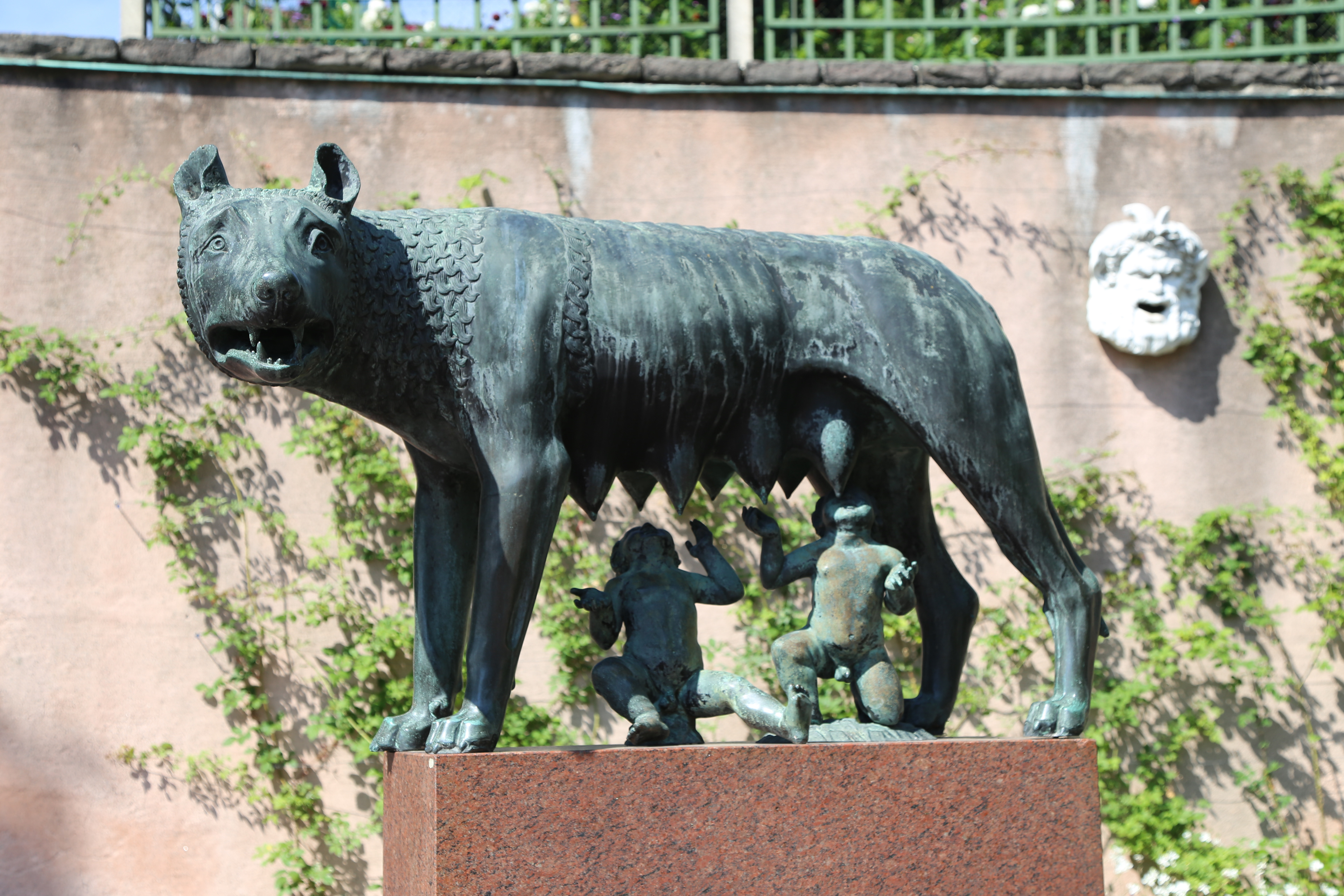
The myth is a political document as much as a narrative. Every element carries meaning that the Romans understood and deployed. The divine paternity — Mars as the twins’ father — gives Rome a martial origin and explains, retrospectively, the military character that made the city what it was. The exposure and survival narrative follows a pattern found across Mediterranean founding myths — Moses, Perseus, Oedipus — in which the hero’s early vulnerability and miraculous survival announces his exceptional destiny. The she-wolf is the crucial Roman addition: the city founded not by a god descending in majesty but by infants suckled by a predator, nourished on wildness before civilization claimed them. There is something in the wolf’s choice — feeding these particular infants rather than eating them — that Romans read as divine favor expressed through nature rather than through supernatural intervention. The wolf did not know she was founding Rome. Rome claimed the wolf anyway.
The fratricide is the myth’s most uncomfortable element and the most revealing. Romulus kills Remus over the location of the city’s boundary — Remus leaps over the wall Romulus has begun to build, in mockery or in challenge, and Romulus kills him with the words let it be so with whoever else leaps my walls, or words to that effect depending on the source. The city is founded in a murder between brothers, and the Romans told this story about themselves without apparent discomfort. Later writers found philosophical content in it — the city’s boundary made sacred by blood, the law enforced from its first moment by lethal sanction — but the myth’s persistence suggests it encoded something the Romans recognized as true about their own political culture: that power was undivided, that the boundary between inside and outside was absolute, and that the founder’s authority admitted no rivals, not even a twin.
The archaeological reality behind the myth is substantially different and substantially less dramatic. Rome grew from a cluster of Iron Age settlements on the hills above the Tiber, coalescing into an urban center sometime in the eighth century BC — which happens to be the period Roman tradition assigned to Romulus’s reign, a coincidence that reflects the myth’s deep roots in genuine historical memory even if its details are invented. The Palatine Hill was settled first or among the first, which is consistent with the founding tradition’s location. There was no single founder, no divine paternity, no she-wolf. There was a gradual process of nucleation in which several hilltop communities merged their economies, their defenses, and eventually their political identities into a single city. Mythology compresses this into a moment and gives the moment a name.
The Capitoline Wolf — the original bronze in the Capitoline Museums in Rome — has its own complicated history that adds an unexpected layer to the symbol’s meaning. For centuries the wolf was dated to the Etruscan period, fifth century BC, and presented as Rome’s oldest civic monument. A more recent analysis using thermoluminescence dating, published in 2006, suggested a medieval date — possibly eleventh or twelfth century AD — which would make the wolf a medieval object rather than an ancient one, recast or newly made at a period when Roman civic identity was being consciously reconstructed. The dating remains disputed among specialists. What is not disputed is that the twin infants beneath the wolf were added in the fifteenth century by the Florentine sculptor Antonio Pollaiolo, commissioned by Pope Sixtus IV. The most famous image of Rome’s founding is partly a Renaissance addition to a bronze of uncertain ancient or medieval date. The symbol’s authenticity as an object does not match its authenticity as an idea, which has been continuous and genuine from the Republic onward regardless of when the specific bronze was cast.
The image’s political utility across Roman history was consistent and deliberate. Coins showing the wolf and twins appeared by the third century BC and circulated across the Mediterranean as Rome expanded, carrying the founding image into territories that had no other reason to know the story. Augustus, who rebuilt Roman civic religion and national mythology as a political program, promoted the wolf-and-twins imagery as part of the broader effort to give the principate the legitimacy of ancestral continuity. The she-wolf appeared on the shields of the Praetorian Guard. She appeared in the decorative programs of public buildings. She appeared on the silver plate of wealthy households. The image was so thoroughly distributed that it became self-reinforcing — you recognized it because you had seen it everywhere, which made it seem like it had always been everywhere, which made it feel like the permanent truth about Roman identity that Augustus wanted it to feel like.
The afterlife of the image extends well beyond Rome. Cities that claimed Roman descent or Roman connection — Siena, which had its own wolf-and-twins tradition; Reims; countless colonial foundations across the empire — adopted or adapted the image for their own civic identities. Modern Italy uses the wolf on official documents and sports the image on the jersey of AS Roma. Copies of the Capitoline Wolf have been given as diplomatic gifts by the city of Rome to cities across the world — Cincinnati, Chicago, Buenos Aires — in a gesture that packages two thousand years of civic symbolism into a bronze casting. The one in Stockholm, in the garden of Carl Milles, arrived through the particular cultural relationship between Italy and Scandinavia in the early twentieth century, where classical antiquity was a shared aesthetic language among European artists of a certain formation.
The wolf at Millesgården stands in Swedish daylight, slightly incongruous, entirely serious. The twins nurse beneath her without looking up. She looks to the left with the perpetual alertness of an animal that has survived by watching what approaches. In Rome, in Stockholm, in the dozens of other places copies have been placed, the image says the same thing it has always said: something wild kept us alive when the organized world wanted us dead, and we built everything from that beginning. It is not a comfortable origin story. It was never meant to be.