The Oath of the Horatii: David's Roman Republic in Paint
Jacques-Louis David completed The Oath of the Horatii in Rome in 1784 and exhibited it at the Paris Salon the following year. It stopped the room then. It still stops rooms now — visible here on the deep terracotta wall of the Louvre’s Denon Wing, large enough to command the gallery from any angle, the three brothers extending their sword arms toward their father in a gesture that has not lost its charge in two and a half centuries.
The subject is Livy. Rome and Alba Longa, locked in a war neither city wants to prosecute at full scale, agree to settle the conflict through a contest of champions: three Horatii brothers against three Curiatii brothers. The problem is that a Horatii sister is betrothed to a Curiatii, and a Horatii brother is married to another. The families are bound by love and about to be divided by combat. David paints the moment before — the oath, the commitment, the point of no return.
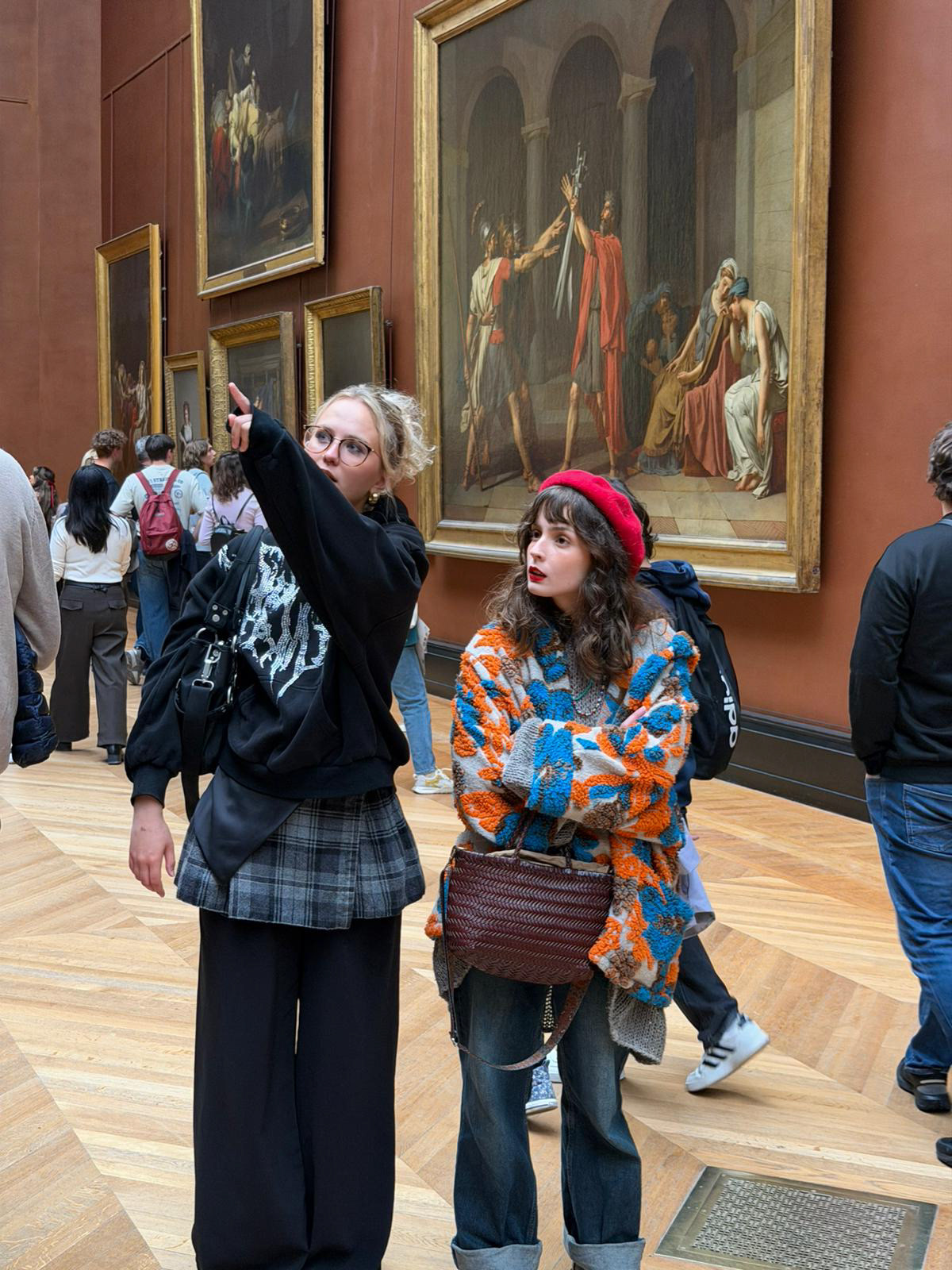
The composition is severe and deliberate. Three arches in the background, one per brother. The male figures occupy the left and center: angular, locked, resolute. The women collapse into the right side of the canvas — grief already present, not anticipated. The father holds the swords at the convergence point. Everything moves toward that center and stops there.
David had spent years in Rome studying antiquity directly, and it shows in the armor, the sandals, the architectural setting. But the painting is not archaeology. It is argument. Painted five years before the Revolution, it articulated something the French political class was already feeling: that civic duty could demand the subordination of private feeling to public obligation. The Horatii brothers are not happy. They are committed. That distinction is the painting’s entire moral content.
What is easy to miss standing in front of it today is how saturated David’s original audience was in exactly this material. In late 18th-century educated European society, Roman Republican history was not a specialty. It was the common reference pool. Schoolboys read Livy and Plutarch in Latin before they read anything else. Politicians quoted Cicero from memory in legislative chambers. Architects named buildings after Roman precedents, painters competed for prizes requiring Roman subjects, playwrights staged Roman tragedies to full houses. When David exhibited the Horatii in 1785, his audience did not need a wall label. They knew Livy. They knew what the oath meant, what the fratricide meant, what Rome’s acquittal of the brother meant. The painting landed as a political provocation precisely because the reference was instantly legible to everyone in the room. The gap between that world and the Louvre today — where two young women in a patterned sweater and a red beret point at the canvas with the cheerful blankness of people encountering something large and old — is not a failure of attention. It is a civilizational distance. The Roman Republic as a living moral vocabulary, a set of stories that educated people held in common and argued over, is gone. What remains is the painting, still legible as an image of commitment even when the specific story behind it has become obscure. David built it well enough that it survives the loss of its context. Not every painting does.
One of the three brothers will survive the combat — wounded, hunted down the surviving Curiatii one by one. When he returns to Rome and finds his sister weeping for her dead betrothed, he kills her. Rome tries him for murder. His father defends him. Rome acquits. Livy records this without apparent discomfort. David paints the oath and leaves the rest to the viewer’s knowledge of what comes next.
The painting is in Salle 702 of the Louvre, among the large-format French history paintings of the late 18th and early 19th centuries. It hangs near David’s Intervention of the Sabine Women and Leonidas at Thermopylae, which form an informal trilogy of civic virtue under pressure. The Oath is the most tightly constructed of the three and the one that established David’s reputation as the painter of Republican Rome for a France that was about to need exactly that image.