Caesarea Maritima: A Roman City Built from Nothing
Caesarea Maritima was built by Herod the Great on a site with no natural harbor, no fresh water source, and no existing urban infrastructure, over a period of approximately twelve years ending around 10 BC, and it became the capital of the Roman province of Judaea and one of the most important cities on the eastern Mediterranean coast. The feat of urban creation involved harbor engineering that modern marine archaeologists have called the most ambitious building project in the ancient world: an artificial harbor of roughly 100,000 square meters created by sinking enormous concrete blocks into water sixty meters deep, using hydraulic concrete — the pozzolanic technology that gave Roman harbor structures their extraordinary durability — in its most ambitious application anywhere in the empire. The harbor blocks, two thousand years later, still lie beneath the Mediterranean, structurally recognizable and studied by diving archaeologists who find in them evidence of Roman engineering at its most technically extraordinary.
Herod built Caesarea for a specific political purpose: to give his kingdom a world-class port city that would both serve his commercial interests and demonstrate his cultural alignment with Roman civilization. He named it for Augustus — Kaisareia — and dedicated a temple to Roma and Augustus that was visible from far out at sea, an architectural statement of loyalty that anyone approaching the harbor could read before they had entered the city. Herod was a client king, dependent on Roman support for his throne, and his building programs throughout his kingdom were partly expressions of genuine architectural ambition and partly political performances for the Roman audience whose continued patronage his dynasty required.
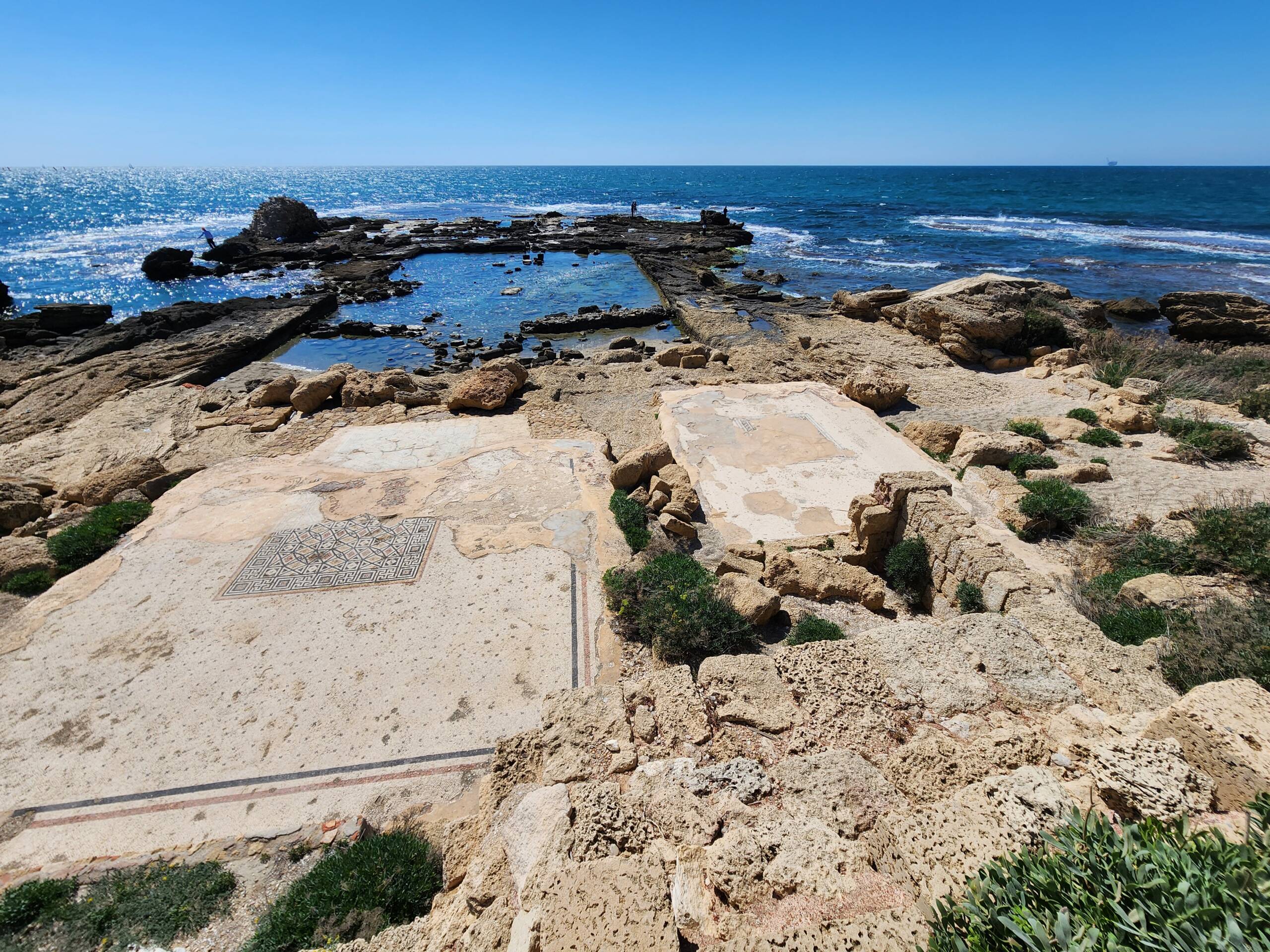
What the site gives you today, if you stand at its western edge, is something the photographs do not fully prepare you for: Roman mosaic floors exposed at the lip of the Mediterranean, geometric patterns in black and white still legible against the stone, with the sea behind them and the waves audible below. These are the bathhouse floors of the Herodian palace complex — a structure built deliberately at the water’s edge, combining the Roman bath with a seawater pool, the piscina, cut into the living rock of the coastline. The mosaic survived because the Roman concrete beneath it survived. The sea has been working on it for two thousand years and the pattern is still there. You stand on the edge of a cliff in Israel and look at a Roman floor looking out at the same Mediterranean it was always looking at, and the distance between then and now collapses in a way that more sheltered ruins do not produce.
The city’s planning followed the Roman grid: decumanus and cardo, the main streets crossing at right angles, with the forum and temple complex at the intersection. The theater, seating four thousand people, was built facing the sea and is still used for performances today — one of the best-preserved ancient theaters in the region. The hippodrome for chariot racing ran along the harbor, a long narrow track whose ruins are visible from the air.
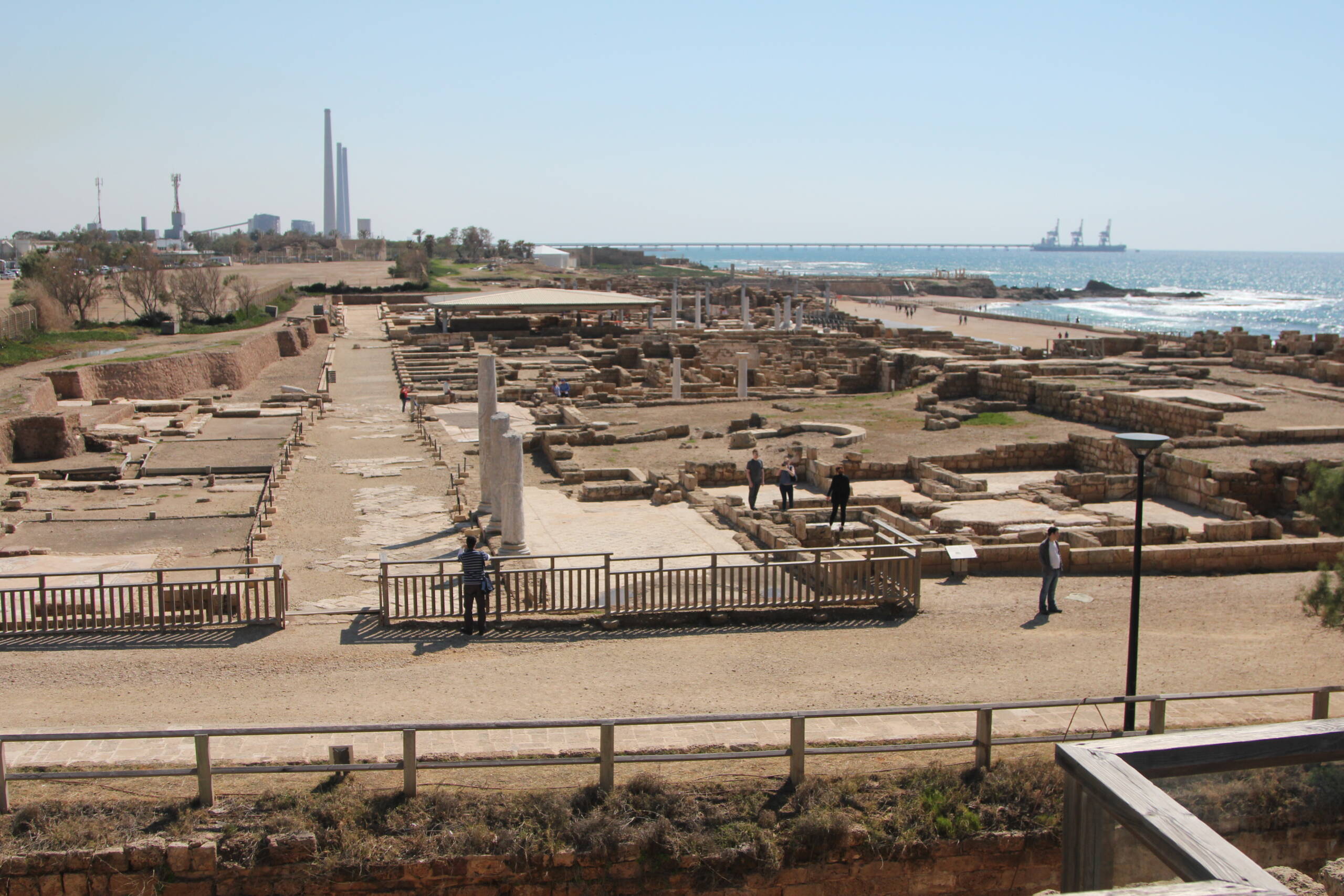
The scale of the site registers best from elevation. Looking across the excavated zone toward the sea — the partially reconstructed columns, the exposed room foundations, the grid of walls running down toward the waterfront — you understand that what Herod built was not a modest provincial installation but a city of the first order, designed and executed at full Roman urban ambition. The modern power plant chimneys visible on the northern horizon are an accidental reminder of what continuity of strategic location looks like: Caesarea was chosen for the same reasons that industrial infrastructure eventually arrived near the same stretch of coast. The site that made sense for a Roman harbor made sense for everything that followed it.
The aqueduct that brought fresh water from springs at Mount Carmel, fourteen kilometers to the north, ran on a series of arches across the coastal plain that are still largely standing. The harbor facilities went through successive developments that reflect the increasing scale of Roman maritime commerce. The emperor Claudius’s harbor, constructed in the 40s AD, added an artificial basin large enough to accommodate the large grain ships that crossed the Mediterranean. Trajan deepened and extended the facility with a hexagonal inner harbor, creating a sheltered anchorage substantially more usable than the earlier structure. The Portus that resulted became the primary entry point for the province’s maritime imports and exports, the physical mechanism through which Caesarea connected Judaea to the Mediterranean economy.
The city became the administrative center of Roman Judaea in 6 AD when direct Roman governance replaced Herodian client kingship over the province. The governors who administered the region — including Pontius Pilate, prefect from 26 to 36 AD — were based at Caesarea rather than Jerusalem. An inscription discovered at Caesarea in 1961 bearing Pilate’s name is one of the few contemporary archaeological attestations of any figure mentioned in the New Testament gospels, and its discovery resolved a long-standing debate about whether Pilate’s title was prefect or procurator — the inscription confirms prefect for his period.
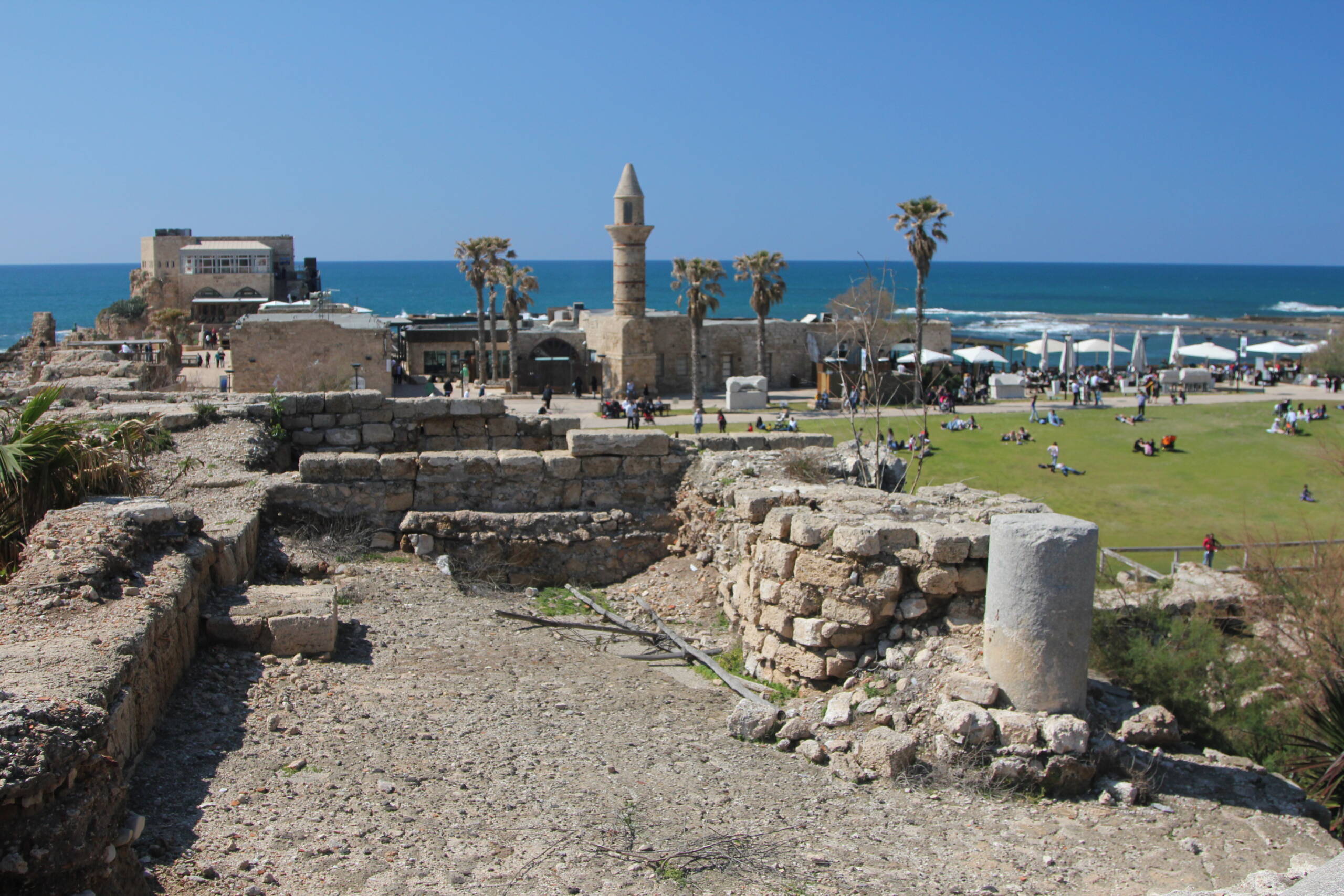
Stand in the right spot at Caesarea and you can see the entire site’s biography simultaneously: Roman foundation walls and a truncated column in the foreground, Crusader-era mosque and minaret rising behind them, a green lawn full of visitors beyond that, and the Mediterranean behind everything. No single photograph of an ancient site more efficiently compresses what happened to the Roman world in the centuries after Rome: the legions left, the Byzantines modified what remained, the Arabs conquered and built their own structures on Roman foundations, the Crusaders arrived and built on Arab foundations, and today Israeli families picnic on grass planted over all of it. The Roman city is underneath everything, holding up the weight of fifteen centuries of subsequent occupation by virtue of having been built well enough to serve as a foundation for whatever came next.
The cultural life of the city at its height was diverse and occasionally explosive. The Christian community at Caesarea was among the earliest and most important in the Mediterranean world — Paul of Tarsus passed through it repeatedly, Origen established his famous library there in the third century, and Eusebius of Caesarea used that library’s resources to write the ecclesiastical history that remains a primary source for early Christian scholarship. The Jewish community was substantial and its relationship with the Greek-Syrian population generated the tensions that contributed to the Jewish revolt of 66 AD. This was a city of competing populations and competing claims, held together by Roman administration and commercial interdependence.
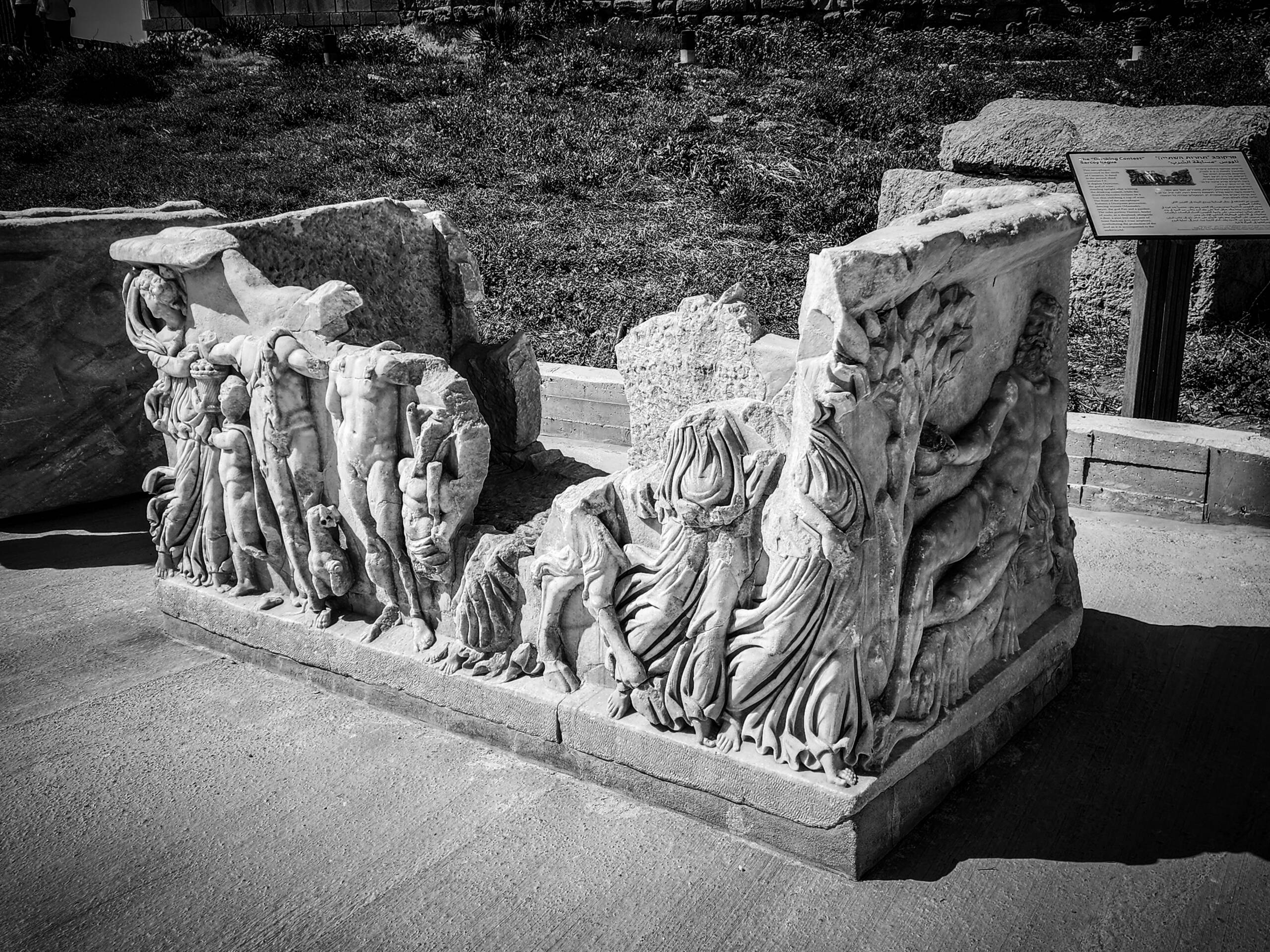
Among the sculptural pieces that remain at the site is this marble sarcophagus — the Drinking Contest, as it is known — depicting in high relief the mythological competition between Dionysus and Hercules to determine which of them could consume more wine. The narrative runs across the face of the sarcophagus in the crowded, overlapping figures characteristic of the Roman mythological relief tradition: divine contestants, attendants, the paraphernalia of the symposium, a figure slumped in the unmistakable posture of someone who has lost the competition decisively. It is a subject that appears on Roman sarcophagi across the Mediterranean, chosen for burial contexts not merely as decoration but as theological statement — Dionysus as the god of transformation and afterlife, the drinking contest as a metaphor for the passage from one state to another. That this piece ended up at Caesarea, a city built by a Jewish king for a Roman imperial patron in a territory that would become central to the development of Christianity, captures the extraordinary cultural complexity of the Roman provincial world. The myths traveled with the marble.
The earthquake of 526 AD and the Arab conquest of the 630s AD effectively ended the Roman-Byzantine city as a functioning urban organism. The site that became what you visit today bears the marks of every subsequent occupation, but the Roman engineering beneath it all — the harbor concrete still on the seabed, the mosaic floors at the cliff’s edge, the aqueduct arches still standing across the coastal plain — remains the structural fact around which everything else organizes itself. Caesarea was Herod’s creation, then Rome’s administrative center, then Christianity’s scholarly capital, then a Crusader fortification, then an archaeological site. It was always, in some sense, the thing that Roman harbor engineering had made possible: a city where none should have existed, on a coast where the sea offered no natural advantage, built by the force of imperial will and the durability of pozzolanic concrete.