Ostia: The Port That Fed Rome
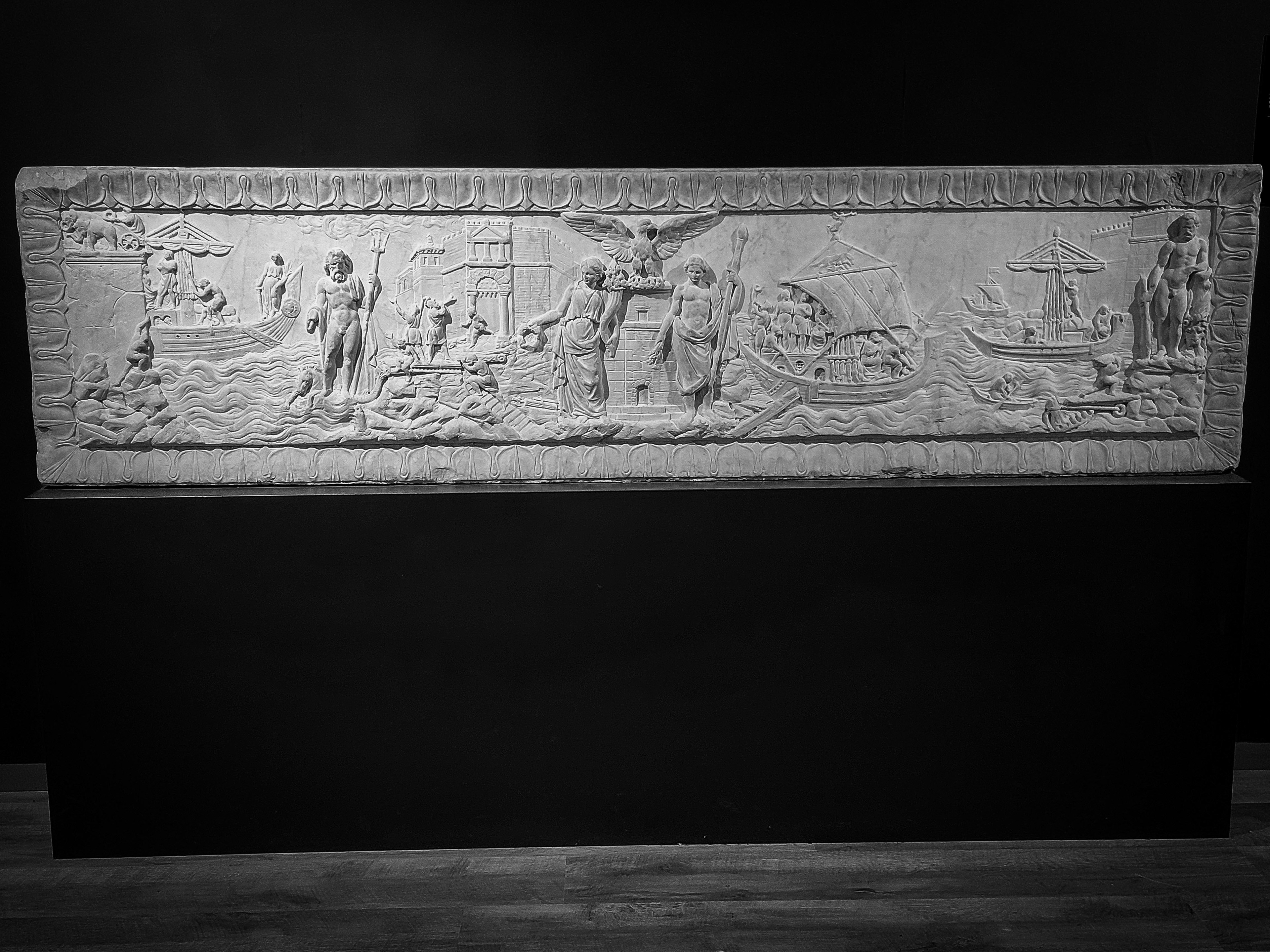
In the National Maritime Museum in Haifa, a marble sarcophagus panel from sixteenth-century Italy shows the ancient port of Rome in relief: harbor buildings rising from the waterline, ships under sail and oar working the channel, a colossal Neptune with trident presiding over the scene, an eagle spreading its wings above the central composition, figures on the quayside conducting the business of a working port. The label identifies the subject as the ancient harbor of Rome — Ostia Antica — depicted on a burial monument perhaps fifteen hundred years after the port it celebrates ceased to function. Someone in Renaissance Italy thought the harbor of ancient Rome was worth putting on a coffin. The choice tells you something about how the ancient port’s reputation persisted long after the silt had closed it.
Rome could not feed itself. The city that consumed the products of an empire — grain from Egypt and North Africa, wine from Gaul and Spain, olive oil from the eastern Mediterranean, luxury goods from as far as India and China — sat on the Tiber sixteen kilometers from the sea, connected to the Mediterranean economy through a harbor at the river’s mouth and the logistical infrastructure that moved commodities from ships to warehouses to the city’s tables. Ostia was that infrastructure, and understanding it means understanding how an ancient city of half a million or more people solved the supply problem that has defeated urban civilizations throughout history.
The harbor settlement at the Tiber mouth dates to the fourth century BC, making it among Rome’s earliest colonial foundations, established to control river access and provide a military base on the coast. What turned it into a commercial city of the first order was the growth of Rome itself: as the city’s population increased, so did its requirements, and as its requirements increased, the scale of maritime commerce necessary to meet them increased proportionally. By the early Empire, Ostia had become a substantial city in its own right — its own temples, baths, theaters, forums, warehouses — organized around the single overriding economic function of receiving, storing, and forwarding the goods that the capital required.
The harbor facilities went through successive developments that reflect the increasing scale of Roman maritime commerce. The natural river mouth offered limited depth and was subject to silting and storm damage; the emperor Claudius’s harbor, constructed north of Ostia in the 40s AD, added an artificial basin large enough to accommodate the large grain ships that crossed the Mediterranean from Alexandria and Carthage. Trajan deepened and extended the facility with a hexagonal inner harbor connected to the outer basin, creating a sheltered anchorage that was substantially more usable than the earlier structure. The Portus Augusti — expanded under Trajan as Portus Traiani — became the primary entry point for Rome’s maritime imports, with Ostia serving as the administrative center and warehouse complex for the goods that passed through. The Neptune who presides over the Haifa sarcophagus was invoked by every sailor who navigated these waters; the god of the sea was the implicit partner in every transaction the port conducted.
The warehouses — horrea — were Ostia’s defining architectural feature, as revealing of the city’s function as the thermopolia were of Rome’s street food culture. The horrea were massive rectangular structures organized around internal courtyards, with rows of storage rooms opening onto colonnaded galleries. Some were specialized — the horrea built to store grain under conditions that prevented moisture damage, the horrea for wine amphoras, the horrea for other commodities — while others were general. The scale was industrial: the Grandi Horrea, among the largest surviving examples, had over sixty storage rooms in a single complex. The total warehouse capacity at Ostia was sufficient to hold several months’ supply of Rome’s grain requirements, providing a buffer against supply disruptions that the city could not otherwise have managed.
The workers who moved goods through this system were organized into corporations — collegia — that combined commercial function, religious observance, and social solidarity in characteristically Roman fashion. The Piazzale delle Corporazioni at Ostia, a porticoed square surrounding a theater whose colonnade was decorated with mosaic emblems of the various trading corporations and their home cities, shows the reach of the commercial network Ostia connected: representatives from Carthage, Alexandria, Sabratha, Narbonne, and dozens of other Mediterranean ports maintained offices in the square, advertising their commodities and shipping services to Roman buyers. The harbor the Haifa sarcophagus depicts was one end of a system that extended to every shore of the Mediterranean.
The city’s social composition was thoroughly mixed. Freedmen were dominant in trade and commerce; the working population included people from across the Mediterranean world; the inscriptions reveal a religious diversity — temples to Mithras, to Isis, to the Syrian gods, as well as the Roman state cults — that reflects the mobile, cosmopolitan character of a port city where sailors, merchants, and workers arrived from every direction.
Its decline followed the pattern of silting that defeated every ancient Mediterranean harbor eventually. By the fifth century the harbor was substantially unusable, and the city’s population had declined dramatically. Medieval Ostia — the small fortified town visible near the archaeological site today — is a footnote to the city that once processed the food supply of the ancient world’s largest metropolis. What the excavations have exposed — and Ostia is among the most extensively excavated ancient cities outside Pompeii — is a snapshot of a commercial city at full operation in the second and early third centuries AD, the prosaic and indispensable engine of Roman urban life.
The Renaissance sculptor who put this harbor on a sarcophagus was working with a specific iconographic tradition: Neptune as the presiding deity of maritime prosperity, the harbor as a symbol of commerce and connectivity, ships as evidence of human reach across the world’s waters. What he preserved, in marble, is a vision of what the ancient port looked like at operational height — the buildings, the ships, the divine patron overhead. The port itself had been gone for over a thousand years when the panel was carved. The reputation had not gone anywhere. In a maritime museum on the Israeli coast, in the twenty-first century, it still draws a crowd.