Caligula: What the Sources Say About the Mad Emperor, and What They Invented
Gaius Julius Caesar Germanicus ruled Rome for three years and ten months, from March 37 CE to January 41 CE. He was 24 when he took power and 28 when officers of his own Praetorian Guard cut him down in a corridor on the Palatine during the games. Rome has been arguing about what happened in between for two thousand years, and almost everything in the argument comes from men who never met him.
That last point is where any honest account of Caligula has to start. The famous stories, the horse, the sisters, the seashells, the wish that the Roman people had a single neck, come mostly from Suetonius, writing about eighty years after the murder, and from Cassius Dio, writing nearly two centuries after it. Tacitus covered the reign in the Annals, but those books are lost. The two writers who actually knew him, the philosopher Seneca and the Jewish envoy Philo of Alexandria, both hated him, and both had personal reasons to.
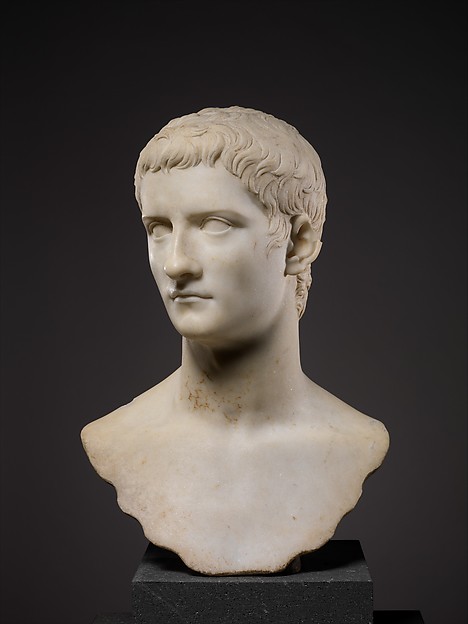
Marble portrait bust of the emperor Gaius (Caligula), 37–41 CE. Metropolitan Museum of Art, Rogers Fund, 1914, Open Access (public domain).
The Met’s bust shows the problem from the other side. It gives him Augustus’s calm, regular features and the family’s carefully arranged locks of hair, because the Julio-Claudian portrait was a dynastic brand, built to say that nothing had changed. The marble wants you to see continuity. The literature wants you to see a monster. Neither is a photograph.
The boy in little boots
He got the nickname as a toddler in his father Germanicus’s camps on the Rhine, where the soldiers dressed him in a miniature uniform with the army boot, the caliga. Caligula means little boot. He disliked it as an adult, which is one reason the senators who wrote him into history used it.
His childhood was a massacre in slow motion. Germanicus died in Syria in 19 CE under suspicious circumstances. His mother Agrippina and his two older brothers were arrested under Tiberius and died in prison or exile. Gaius survived by being quiet on Capri, at Tiberius’s side, for six years. When Tiberius died on 16 March 37, the Senate set aside the old man’s will, which had named his grandson Tiberius Gemellus as co-heir, and handed Gaius the whole empire. Gemellus was dead within a year.
The first months went well, by every account. Tax remissions, recalled exiles, bonuses for the Guard, burned treason files. Then, in the autumn of 37, he fell seriously ill. Philo dates the turn to that illness, and many modern biographies have followed him into a story of brain fever and madness. It’s a neat story. It’s also the story a man in Philo’s position needed: an emperor who went insane is easier to explain than one who made choices.
The horse, the sisters and the shells
Take the horse. Suetonius says Caligula gave Incitatus a marble stall, an ivory manger and a house with slaves, and that he planned to make him consul. Planned. The horse was never consul, and no source says he was. The German historian Aloys Winterling, whose biography is the most influential modern revision, reads the episode as a joke at the Senate’s expense: the most honoured office in Rome, so cheapened that a racehorse could hold it. An insult to senators survives in senatorial history as proof of insanity. That is roughly what you would expect.
The incest charge rests on Suetonius, who says Caligula slept with all three of his sisters. What the record shows is narrower and odder. Coins of 37 CE put Agrippina, Drusilla and Julia on the reverse as personifications of security, harmony and fortune, and when Drusilla died in 38 he had her deified, the first Roman woman to be made a goddess. That’s an emperor building a dynasty on the only blood family he had left. It reads as creepy to Roman senators and to us. It isn’t evidence of a bedroom.
Then the seashells. In 40 CE, Suetonius says, Caligula marched an army to the Channel coast, lined it up for an invasion of Britain, and ordered the soldiers to gather shells as “spoils of the ocean”. Historians have read this as a punishment for troops who refused to sail, as a token marking a modest success, and as a garbled report of a word that could mean both shells and siege huts. None of the readings needs a lunatic. All of them fit an emperor with a cruel sense of theatre.
What the record does support
None of this makes him a misunderstood reformer. After a conspiracy in 39 CE he turned on the Senate with the treason trials Tiberius had used, and the executions were real. He emptied the treasury Tiberius had filled, spending on games, on a bridge of boats across the Bay of Baiae that he rode over in Alexander’s breastplate, and on the two great pleasure ships later recovered from Lake Nemi. He demanded divine honours in the Greek east and ordered his statue set up in the Temple at Jerusalem, an order his governor in Syria stalled until the emperor was dead. Philo’s embassy went to Rome to plead about exactly that, and it’s in Philo that the most vivid and bitter eyewitness portrait survives.
The men who killed him on 24 January 41 also killed his wife Caesonia and their baby daughter. The Senate debated restoring the Republic for about a day. Then the Guard found his uncle Claudius behind a curtain in the palace and made him emperor, which tells you who held power in Rome all along.
So the verdict comes out in two parts. Caligula was autocratic, vindictive and expensive, and he humiliated the senatorial class on purpose. The madness was their explanation, written up by their heirs. Read Suetonius with that in mind and the stories get more interesting. They’re the Senate’s revenge, and the Senate held the pen.
The boy who survived Capri understood that very well. He just didn’t live long enough to write his own version.