Damnatio Memoriae: Rome's War on Memory
In the Altes Museum in Berlin there is a circular painted panel, tempera on wood, roughly 30 centimeters in diameter, made in Egypt around 200 AD. It shows a Roman imperial family in full regalia: a bearded emperor in the upper right wearing the jeweled diadem of the Severan dynasty; his wife beside him on the upper left, dark-eyed and elaborately coiffed; a young man below them in the center wearing his own smaller diadem. A fourth face occupies the lower left — or rather, a fourth face should occupy it. What is there instead is bare wood, scratched down to nothing by something sharp, the ghost of a face removed with deliberate force at some point after the panel was painted. The family portrait has three people in it. It was made to have four.
This is the Severan Tondo, the only surviving painted portrait of a Roman imperial family, acquired from Egypt in 1932. The emperor is Septimius Severus. His wife is Julia Domna. The young man in the center is their son Caracalla. The scratched absence is their other son, Geta. Caracalla murdered Geta in 211 AD, in the arms of their mother, immediately after their father’s death during the Caledonian campaign in Britain. The Senate subsequently passed a decree of damnatio memoriae — condemnation of memory — ordering Geta erased from the official record. His name was chiseled from inscriptions across the empire. His image was removed from monuments. His face was scratched from portraits wherever portraits could be found. The Severan Tondo is what that process looks like on a domestic object: the scratches that ended Geta’s existence in the official visual record, still visible after eighteen centuries, in a Berlin museum case.
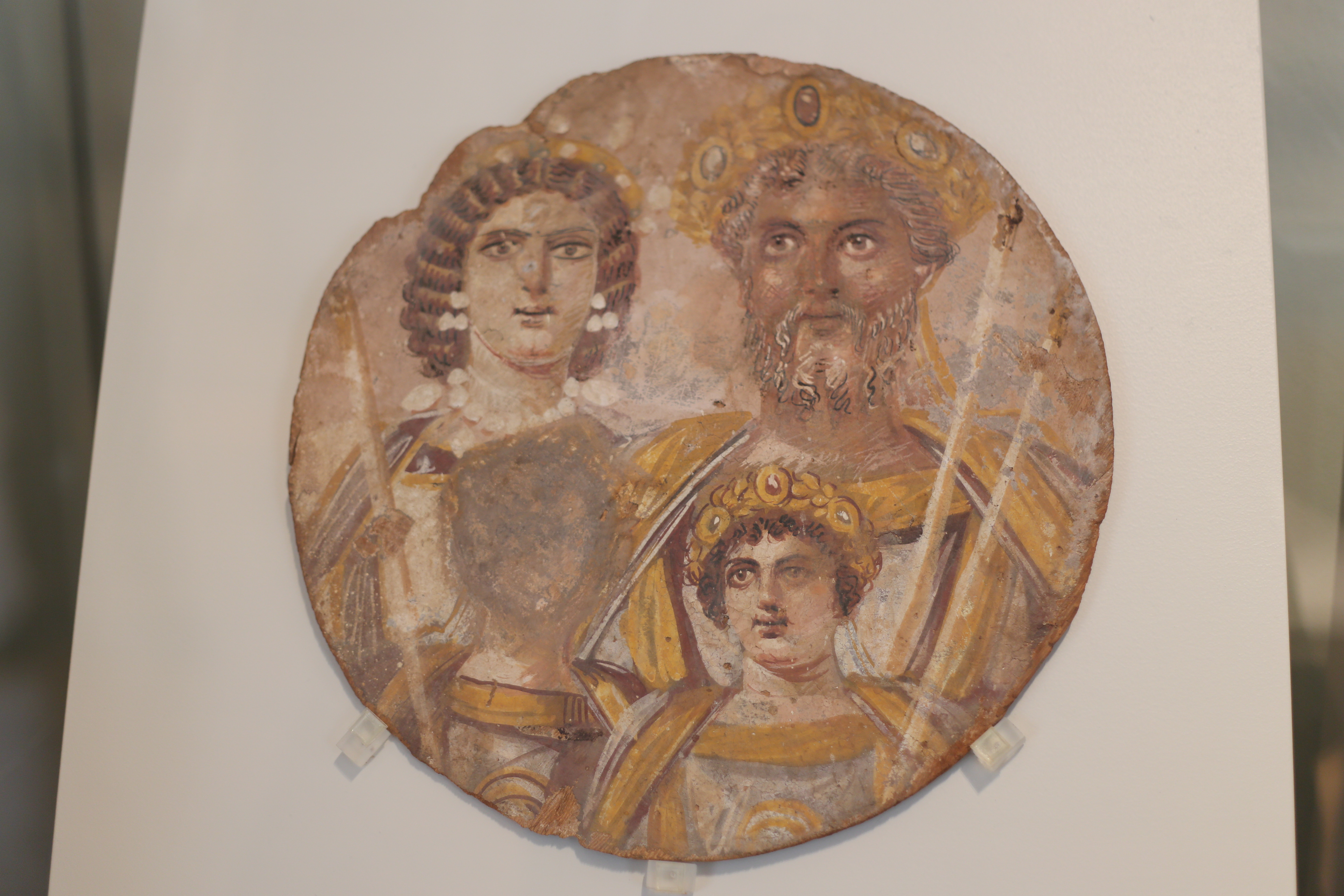
Damnatio memoriae is not a Roman phrase. The term was coined by modern scholars to describe a practice the Romans themselves called by various names — abolitio nominis, erasure of the name; eversio statuarum, overthrow of statues — but never systematized into a single legal category with a fixed name. What it described was a cluster of posthumous punishments applied by Senate decree to emperors, generals, and public figures who had been condemned by the state after death or deposition: the cancellation of honors, the erasure of names from public records, the destruction or modification of images, and occasionally the prohibition of mourning or the denial of burial. It was not a single act but a campaign against the existence of a person in public memory, conducted across every medium in which that person had been recorded.
The practice had republican precedents but became most systematically developed in the imperial period, when the concentration of imperial image-making — the coins, the statues, the inscriptions, the public monuments — provided both the targets for erasure and the administrative machinery to pursue it. An emperor who died in official disgrace or was deposed by his successor left an enormous material legacy distributed across the entire empire: portrait statues in every provincial city, his name on public buildings, his face on the coins in circulation, his image on the military standards. Erasing all of this was a logistical operation of considerable scale, and the evidence of how it was carried out varies from the thorough to the perfunctory depending on the location and the political urgency.
The mechanics differed by medium. Portrait statues were the most straightforwardly addressed: they were removed from public spaces, melted down if bronze or recarved if marble. The recarving option produced some of the more archaeologically interesting results of the damnatio process — portraits of condemned emperors whose faces were reworked into the features of their successors, the underlying structure of the condemned man’s head still visible to close examination beneath the new surface. Domitian’s portraits were recarved into portraits of Nerva and other successors on a scale extensive enough to be documented; the conversion was sometimes so hasty that the new face sits slightly uncomfortably on the older man’s neck. Coins in circulation were harder to address: withdrawing all existing coinage was economically impractical, and the evidence suggests that coins of condemned emperors continued to circulate long after the official erasure decree. The face of Geta appears on coins found throughout the empire despite the damnatio, because the coins were too numerous and too dispersed to recover.
Inscriptions were attacked with chisels, producing the blank rectangles in stone that archaeologists now read as evidence of the erasure itself — the absence of the name more legible, in some cases, than its presence would have been. The Severan dynasty is particularly well represented in the epigraphic record of erasure: Geta’s name appears as a blank in hundreds of inscriptions across the empire, from Hadrian’s Wall in Britain to the eastern provinces, the chiseling carried out by local officials with varying degrees of thoroughness. In some inscriptions the name was completely removed; in others a ghost of the letters remains, legible to anyone who looks at the stone in the right light. The empire was too large and the inscriptions too numerous for the erasure to be complete, which meant that the evidence of the erasure became the evidence of the condemned person’s former existence.
Whether damnatio memoriae actually worked — whether it achieved its stated purpose of removing a person from historical memory — is a question the practice answers by its own survival in the sources. We know about Geta, Domitian, Caligula, Commodus, and the other subjects of condemnation in considerable detail, partly because the historians who recorded their reigns were writing against the backdrop of condemnation and found the contrast between official erasure and actual memory a productive irony to exploit. Tacitus’s account of the Julio-Claudian dynasty, Suetonius’s biographies of the twelve Caesars, Cassius Dio’s history — all of these were written after damnatio decrees had been passed against specific emperors, and all of them document in detail the people who were officially to have been forgotten. The Senate could erase a name from stone. It could not erase it from memory, and it could not prevent historians from writing it back.
What damnatio memoriae accomplished, as distinct from what it intended, was the communication of political judgment to a public that received it through the changed landscape of images and inscriptions. A city whose prominent statue of a former emperor had been removed, or replaced by a different face, understood something about the current regime’s relationship to its predecessor without requiring any verbal explanation. The blank rectangle in an inscription communicated rejection as efficiently as any positive declaration. The practice was propaganda as much as punishment — a public performance of the current regime’s values enacted on the physical remnants of the condemned predecessor’s image.
Caracalla’s murder of Geta was the most nakedly dynastic of the Severan damnatio cases, and Julia Domna’s position in its aftermath was the most brutal: she was present at the murder, the blood on her clothing was her son’s, and she was then required to participate publicly in the condemnation of the son she had watched die. She did so — she had no practical choice — and continued as a significant political figure in Caracalla’s reign until her death in 217 AD, reportedly by voluntary starvation on learning of his assassination. The Severan Tondo shows her in the moment before all of this, painted in the household Egyptian style that produced Rome’s most intimate surviving portraits, her face serene in the way that official portraits always were. She is looking slightly past the viewer. The space to her left, where Geta’s face was, is bare wood.
The panel survived because it ended up in Egypt, far from the centers of imperial administration where the damnatio was most thoroughly enforced. Someone kept it — possibly a family with Severan connections, possibly a household that simply did not carry out the scratching with complete thoroughness and then held the panel through the centuries until it reached the Berlin collection in 1932. The face that was scratched out is gone. The scratching itself remains. That is the Severan Tondo’s final argument about the limits of official erasure: the attempt to destroy the record became part of the record, and the absence it created is as legible as any presence.