Faustina the Younger: The Woman Behind the Philosopher Emperor
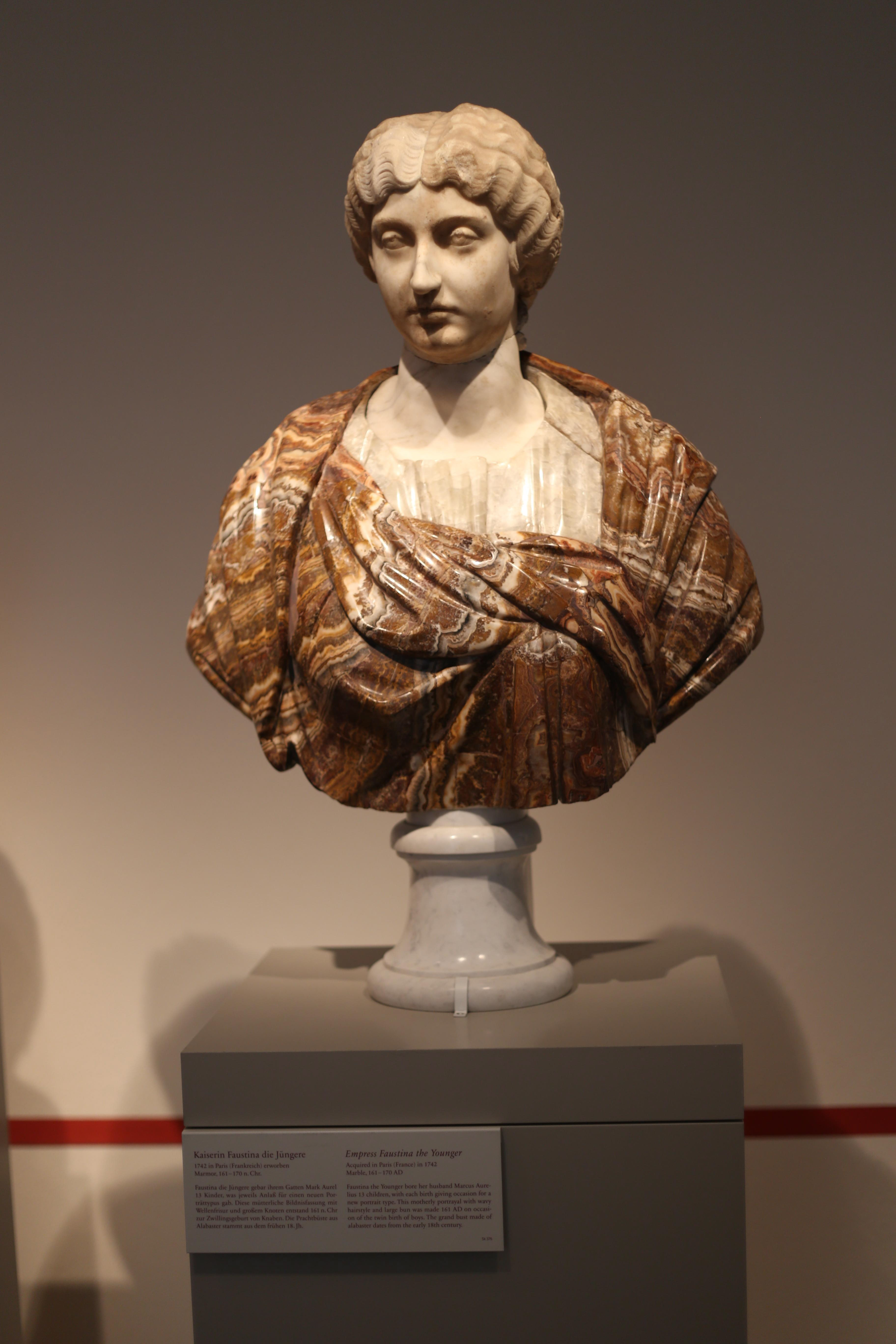
The bust in the Altes Museum in Berlin is one of the more technically striking Roman portrait pieces in any German collection. The head is Carrara marble — white, fine-grained, the standard material for imperial portraiture — but the drapery is carved from a deeply veined breccia, red and brown and amber in layered striations that catch the light differently at every angle. The polychrome combination, fashionable in later reworkings of ancient busts, gives the portrait an unusual visual richness: the cool classical face above the warm geological drama of the clothing. The label identifies her plainly. Kaiserin Faustina die Jüngere. Empress Faustina the Younger. Wife of Marcus Aurelius. Marble, 141–175 AD.
She looks out of the portrait with the composed, slightly remote expression that Roman imperial women’s portraits standardized across the second century — a look engineered for public consumption, projecting dignity and approachability in calibrated measure. It tells you almost nothing about who she was. That is the point. The portrait is an office, not a person. Understanding the person requires looking past the marble to the record, which is fragmentary, often hostile, and consistently more interesting than the official image.
Faustina Minor — the Younger, to distinguish her from her mother Faustina the Elder, wife of Antoninus Pius — was born around 130 AD into the innermost circle of the Antonine dynasty. Her father was the emperor Antoninus Pius. Her betrothal to Marcus Aurelius was arranged by Hadrian as part of the succession plan that would eventually produce the principate’s most admired half-century of governance. She and Marcus were betrothed when she was perhaps two years old and he was fifteen, which tells you something about how the Antonine dynasty understood marriage: not as a personal arrangement but as a constitutional instrument, a mechanism for transmitting power and legitimizing succession through biological connection.
They married in 145 AD, when Faustina was approximately fifteen. The marriage lasted thirty years, until her death. Marcus’s private feelings about it are not directly recorded — the Meditations, his only surviving personal writing, mention her once, in the list of things for which he expresses gratitude: she was obedient, loving, and simple. The phrasing is affectionate and entirely opaque. Roman men of his class and philosophical formation did not write about their wives with the transparency that later epistolary traditions encouraged, and Marcus was additionally constrained by the public nature of everything he wrote, even in what read as private notes.
The ancient sources that do discuss Faustina at length are largely hostile, which is the standard condition for imperial women in Roman historiography. The Historia Augusta — a notoriously unreliable late antique compilation — accuses her of taking gladiators and sailors as lovers, of conspiring with the general Avidius Cassius against her own husband, and of general licentiousness that the author presents as scandalous contrast to Marcus’s philosophical virtue. These accusations follow a template so consistent across different imperial women — Livia, Agrippina, Messalina, Julia Domna — that the template itself becomes the most informative data. Roman men who wrote history found powerful women’s sexuality a convenient explanation for events they found otherwise difficult to account for. The accusations are not impossible and not credible; they are the reflexive response of a literary tradition that had no vocabulary for women exercising power that did not reduce to either virtue or vice.
What Faustina actually did, documented independently of the hostile tradition, is more interesting. She bore thirteen children, of whom only six survived to adulthood — a reproductive history that represents both the biological reality of Roman elite women’s lives and the specific dynastic demands of a family that needed heirs. She was awarded the title of Mater Castrorum — Mother of the Camps — for accompanying Marcus on his Danube campaigns in the 170s AD, a military theater far from Rome where she remained with the army during some of the most difficult fighting of the Marcomannic Wars. This was not standard behavior for imperial women. It required physical endurance, political decision, and a relationship with the troops that the title formally acknowledged. The soldiers gave her the name; Marcus ratified it. Whatever the private texture of their marriage, in public they functioned as a political unit whose coherence each had reason to maintain.
She died in the winter of 175 AD at Halala, a small settlement in Cappadocia where the army was wintering during the eastern campaign that followed the suppression of Avidius Cassius’s revolt. The cause of death is not recorded. Marcus’s response was public and elaborate: he renamed Halala as Faustinopolis in her memory, established a foundation to support orphaned girls called the Puellae Faustinianae in her name, requested her deification from the Senate, and commissioned a commemorative column whose relief sculpture documented her apotheosis. The coins issued in her memory show her ascending to the heavens, carried upward by an eagle. The grief, or the political performance of grief, was sustained and systematic. With Marcus it is never entirely clear which it was, which may be the most honest thing about him.
The deification of imperial women was a specific political technology that the principate had developed across the first and second centuries. A deified empress was a divine ancestor, a source of heavenly intercession, and a legitimating force for the dynasty she had belonged to. Faustina’s deification served Marcus’s political interests in the specific circumstances of 175 AD: he had just suppressed a serious revolt, was managing a fractious frontier, and needed all the legitimating resources available. That her deification was also an expression of personal feeling is probable; the two things were not in conflict and did not need to be separated.
The bust in Berlin is from the period of her active public life — the marble date of 141–175 AD covers her entire adult career — and it shows the Faustina that the imperial image-making apparatus wanted the world to see: composed, dignified, the hairstyle fashionable among Antonine women of her period, the expression calibrated to project authority without threatening it. Every portrait of an imperial Roman woman is partly a portrait of the office and partly a portrait of what the office permitted to be seen. The woman behind the marble — the one who accompanied the army to the Danube, who bore and lost children across three decades, who navigated the impossible position of being the most powerful woman in the world in a political system that had no formal role for her — that woman is recoverable only in fragments, through sources written by men who were not particularly interested in recovering her accurately.
The breccia drapery catches the light in the Altes Museum and changes color depending on where you stand. The white face above it remains constant. That is probably not an allegory. But it is not nothing, either.