Slavery Was the Roman Economy
In the Greek and Roman antiquities hall of the Louvre, in a room of vaulted ceilings and warm museum light, four marble figures stand back-to-back around a central pillar and refuse to let you walk past without stopping. The group is known as the Four Captives — a Roman work, probably inspired by Hellenistic precedents, likely once decorating a monumental structure whose specific identity is lost. What survives is the message, and the message is not subtle.
Each figure is slightly slumped, hands bound behind, torso bent forward in the posture of a man whose situation has just become permanent. The heads are lowered. The shoulders carry visible tension. The hair and beards are rendered with enough individuality that you notice, after a moment, that these are not four copies of the same figure but four separate people — different in bearing, different in the specific way each one absorbs the weight of what has happened to him. Conquered enemies, subdued and displayed, made into decoration for the building of the men who defeated them.
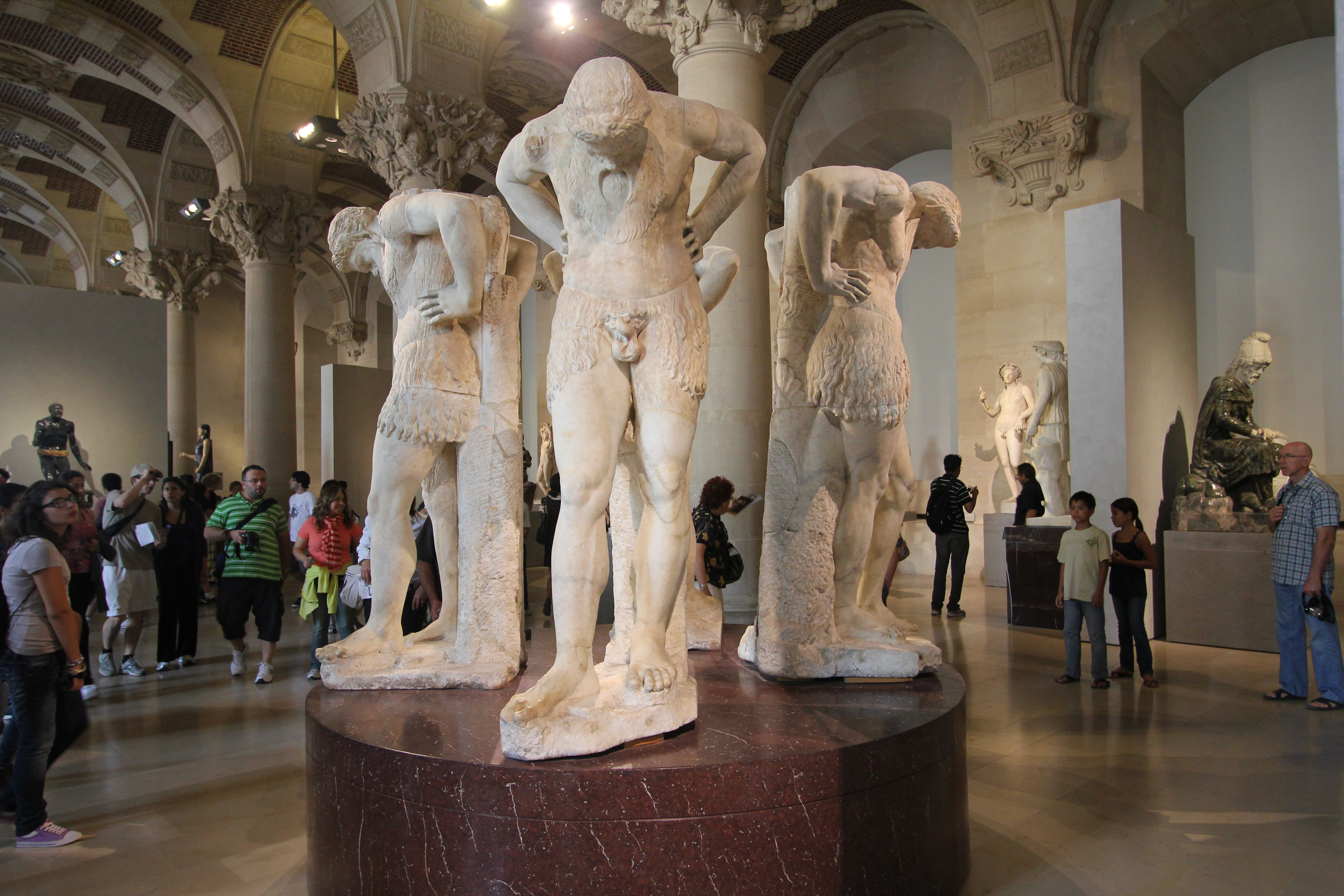
What makes the piece uncomfortable — and it is uncomfortable, in a way that the casually circulating tourists around it seem to sense without quite articulating — is precisely that individuality. The sculptor gave these men enough particularity to suggest that each one had a history before this moment, a life that the capture interrupted. Standing in a bright museum hall surrounded by families taking photographs, the Four Captives feel less like a victory monument than like a record of something that should not have been done. That was not the intention. That is what two thousand years of distance produces.
This is the moment the Roman economy ran on.
Roman slavery was not a feature of the Roman economy. It was the Roman economy, at least for the period of the Republic’s expansion and the early Empire. Understanding Rome without understanding slavery is like understanding a machine by describing everything except the engine. The institution touched every sector of production, every level of social organization, and every city and territory under Roman control. Its scale was not incidental. It was the operating premise.
Estimates of the slave population in Roman Italy at the height of the late Republic — roughly 100 BC to 50 BC — range from 1.5 million to 3 million, out of a total Italian population of perhaps 7 million. This figure, contested but widely cited, would put the slave population at somewhere between twenty and forty percent of the total. In the city of Rome itself the proportion may have been higher. On the great agricultural estates of Sicily and southern Italy — the latifundia that dominated commodity production — slaves constituted virtually the entire workforce. The displacement of small farmers that the Gracchi were trying to address was partly a displacement caused by slave competition: a landowner using slave labor could undercut free peasants on cost, and the flood of enslaved people from Rome’s conquests made this displacement systematic.
The supply mechanism was conquest. Rome’s military expansion was, among other things, a slave-acquisition operation. After the defeat of Carthage, Julius Caesar’s campaigns in Gaul reportedly yielded a million slaves. The destruction of Corinth in 146 BC enslaved the entire surviving population. The suppression of slave revolts in Sicily and of Spartacus’s rebellion in Italy generated further enslaved populations from the defeated. The market at Delos, at its peak, reportedly processed ten thousand slaves per day. These are ancient figures and should be treated with appropriate skepticism, but the order of magnitude is not seriously disputed.
The Four Captives show the beginning of that process — the moment of capture, the binding, the reduction of a person to a transportable asset. Between the marble figures in the Louvre and the slave market at Delos lay a journey of weeks or months, a chain of traders, a series of transactions, and finally a sale to whoever needed labor and could pay. The individuality that the sculptor preserved — those four separate faces, those four distinct ways of carrying defeat — would be erased by the system they were about to enter. A slave in Rome’s legal vocabulary was res: a thing. The sculptor made men. The economy made property.
Slaves in Rome occupied a spectrum from the utterly degraded to the functionally powerful. Agricultural slaves on large estates and slaves in the mines worked under conditions that amounted to slow execution — life expectancy was short, treatment was brutal, and escape or manumission was rarely available. Urban slaves occupied very different positions. Educated Greek slaves served as tutors, secretaries, doctors, and accountants in elite households, sometimes accumulating wealth and influence that exceeded that of free poor citizens. Imperial slaves — slaves of the emperor’s household — managed administrative functions across the empire and wielded real authority over free provincials. The category of slave covered an enormous range of human experience.
The legal status was absolute in theory and negotiated in practice. A slave was property — res, a thing — with no legal standing, no family rights, and no protection against the owner’s will. In practice, economic self-interest moderated treatment: a skilled slave was an investment, and destroying an investment was irrational. The institution of the peculium — a fund that a slave could accumulate and ultimately use to purchase their own freedom — was not legally required but was widely practiced because it created incentives for performance. Manumission was common enough that freed slaves — liberti — constituted a significant social class, and the children of freed slaves were full Roman citizens.
The Spartacus rebellion of 73–71 BC is the most famous of several major slave revolts, and its suppression — six thousand crucified along the Appian Way — was calibrated as much for its visibility as its finality. It changed nothing structurally. Slavery was too embedded in Roman production to be reformed away, and no political movement in Rome ever seriously proposed abolition. The philosophical objections to slavery that appear in Roman literature — Seneca’s letters are the most striking — were individual moral positions without institutional consequence.
Slavery’s decline in the late Empire was not a moral development. It was an economic one. As conquest slowed and the supply of enslaved people from military campaigns decreased, slave prices rose. Alternative labor arrangements — the coloni, tenant farmers tied to the land in ways that prefigured medieval serfdom — became more cost-effective. The transition from slave to serf was not freedom; it was a different form of coerced labor for a different economic era.
The Roman economy was not built on slavery because Romans lacked alternatives. It was built on slavery because conquest made slaves cheap, and cheap coerced labor is always the rational choice for those with the power to impose it. The moral economy of Rome accepted this without serious challenge for centuries, and the literary culture that produced Virgil, Cicero, and Seneca also produced the mines of Spain and the latifundia of Sicily. These were not contradictions. They were the same system, functioning as designed.
The Four Captives stand in the Louvre because someone thought they were beautiful enough to preserve. They were made to project power. They ended up projecting something more complicated — the human cost of an economy that the civilization resting on top of it preferred not to examine too closely. The tourists drift past. Some stop. Most don’t entirely know why.