Spartacus: The Slave Who Terrified Rome
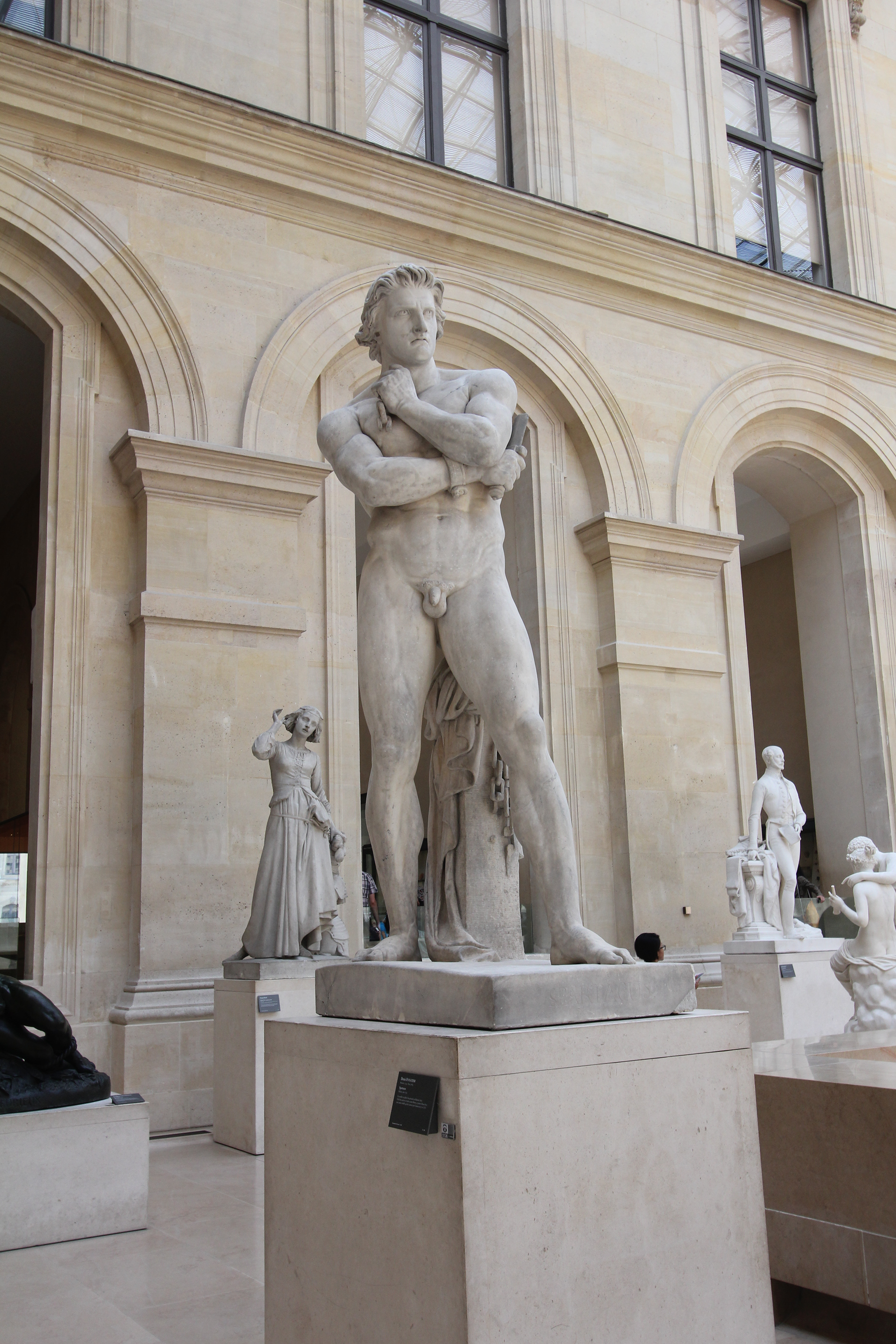
Denis Foyatier carved this Spartacus in 1830 and put him in the Louvre’s Cour Puget, where he has stood ever since in a room of arched windows and pale stone, looking out over the other sculptures with an expression that is not quite triumph and not quite grief. The arms are crossed over his chest. The body is athletic, coiled without being in motion. A broken chain dangles from his wrist — the moment of liberation captured in marble, though Foyatier was careful not to make the moment simple. The face is the point: this is not a victor. This is a man who has just broken free and is now confronting what that means, which turns out to be a harder problem than the breaking.
Foyatier made this in the year of revolutions, which was not accidental. The nineteenth century had particular use for Spartacus — the escaped slave who raised an army, the underclass leader who humiliated the republic’s finest generals, the man who came closer than anyone in Roman history to breaking the system that produced him. Every generation that needed a symbol of legitimate rebellion against illegitimate power found one here. Marx wrote about him. Toussaint Louverture was compared to him. He has never stopped being useful, which means he has never stopped being simplified, which means the actual historical figure has largely disappeared beneath the accumulated weight of what subsequent centuries needed him to represent.
The actual Spartacus was a Thracian — from the region of modern Bulgaria — who had served as an auxiliary in the Roman military before being enslaved, probably as a prisoner of war or deserter, and sold to the gladiatorial training school of Gnaeus Cornelius Lentulus Batiatus at Capua. In 73 BC, he led approximately seventy or eighty men in an escape from the school using kitchen implements as weapons, seized a supply of gladiatorial arms from a passing wagon, and retreated to the slopes of Vesuvius. This was the beginning of what the Romans called the Third Servile War, though they might more accurately have called it the war they almost lost.
The initial Roman response was contemptuous. A slave revolt in southern Italy was a police problem, not a military one. The praetor Gaius Claudius Glaber was sent with roughly three thousand men to blockade Spartacus on Vesuvius — a simple containment operation, or so it seemed. Spartacus’s forces made ropes from wild vines, descended the sheer face of the volcano where no Roman guard had been posted, attacked the Roman camp from the rear, and destroyed the force. The contempt did not survive that engagement.
Over the following two years, the rebel force grew to somewhere between seventy thousand and one hundred twenty thousand people — estimates from ancient sources vary and are probably inflated, but the scale was beyond anything Roman slave revolts had previously produced. Spartacus won engagement after engagement against increasingly serious Roman forces. He defeated two consular armies in 72 BC in a series of battles in southern Italy that demonstrated tactical ability the ancient sources, even those writing from the Roman perspective, acknowledged with reluctant precision. The Senate was alarmed enough to appoint Marcus Licinius Crassus — one of the wealthiest men in Rome — to command the suppression with full praetorian authority and eight legions.
What Spartacus intended to do with his army is the question that neither the ancient sources nor modern historians have fully resolved. One tradition holds that he wanted to lead the enslaved people north over the Alps and disperse them to their home territories — that the goal was escape, not confrontation. Another holds that he turned south toward Sicily to cross to that island and raise a general slave revolt there. The ancient sources report both possibilities and both failures: the Gallic and Germanic contingents in his force refused to march north, preferring to raid Italy; the Sicilian crossing was blocked when the Cilician pirates he had hired to transport the army took Crassus’s money instead and sailed away. Whatever the plan, it did not survive contact with the internal politics of a coalition held together by military success and nothing else.
The final engagements in 71 BC went against Spartacus. Crassus’s systematic campaign, combined with the arrival of Pompey’s forces from Spain and Lucullus’s from the east — neither of whom had been invited — cornered the rebel army in Calabria. The last battle, location disputed, destroyed the force. Spartacus died fighting, reportedly attempting to reach Crassus in personal combat and killed before he could. His body was never identified. The six thousand prisoners taken in the aftermath were crucified along the full length of the Appian Way from Capua to Rome — one cross every thirty-five meters, for a hundred and twenty miles — where they were left to serve as a message about what the system did to those who challenged it. The message was designed to be impossible to ignore. Nobody traveling the road to Rome could.
What the revolt revealed was not that the Roman slave system was vulnerable to overthrow — it was not, and Spartacus came nowhere near overthrowing it — but that it was capable of generating military force of a quality that the republic’s professional armies found genuinely difficult to suppress. A man who had been property led an army of people who were property to victories over Roman consuls, and the republic needed three years, eight legions, and three of its most capable commanders to end it. The system absorbed the shock and continued unchanged, which is what systems do when they are strong enough. The six thousand crosses were the system’s answer to the question of whether it could be broken from inside.
Foyatier’s Spartacus does not know how the story ends. He stands in the moment just after the chains break and just before everything else begins — the improvised weapons, the volcanic descent, the victories that nobody expected, the final battle that nobody survived. The broken chain on his wrist is the only past visible in the sculpture. The expression is all future, and it is not a simple one. The nineteenth century wanted a hero. Foyatier gave it something more accurate: a man looking at the consequences of what he has just done, not yet knowing what they will be, deciding anyway to go forward. That is a more useful Spartacus than the symbol, and a more honest one.