Jean-Léon Gérôme: The Victorian Gaze on Rome
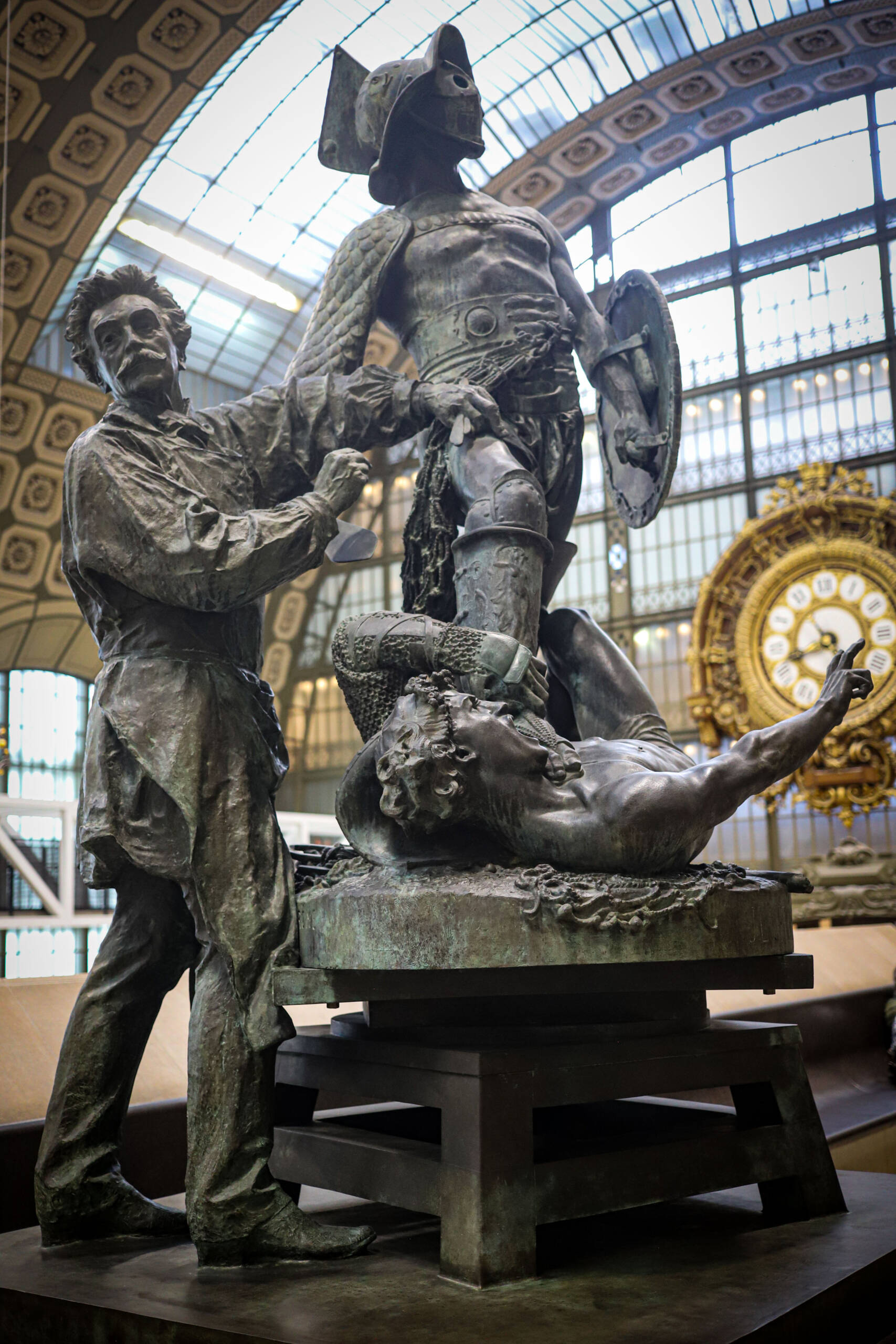
In the main hall of the Musée d’Orsay in Paris, beneath the vast iron-and-glass vault of the former railway station, stands a bronze that makes explicit what Gérôme’s paintings kept implicit. A man in contemporary nineteenth-century dress — smock, trousers, the clothes of a working artist — stands beside a Roman gladiator. The gladiator is armored, helmeted, standing over a fallen opponent whose arm is raised in the gesture of submission. The contemporary figure reaches toward the gladiator with a sculptor’s tool. This is Jean-Léon Gérôme’s self-portrait with his own creation: the artist inside the ancient world he spent his career constructing, the boundary between the nineteenth century and the Roman arena dissolved by the act of making.
The sculpture collapses the distance that Gérôme’s paintings maintained. In Pollice Verso, his most famous canvas, the viewer observes the Roman arena from outside — we watch the crowd, the fallen gladiator, the gesture of condemnation, the armored victor awaiting the verdict. The historical distance is preserved; we are modern observers looking at a reconstructed ancient event. In the Orsay sculpture, Gérôme puts himself in the frame. He is not observing the Roman world; he is making it, standing beside it, implicated in it. The self-portrait is also a confession: this Rome is not discovered but invented, and the inventor is present.
Gérôme painted ancient Rome with a photographic precision that predated photography and an erotic intensity that his academic credentials barely contained. His Pollice Verso of 1872 — a fallen gladiator awaiting the crowd’s verdict while the victorious fighter stands over him, the Vestal Virgins in the background turning their thumbs — is probably the single most influential painting of ancient Rome ever made, not because it is the most important or the most accurate but because it shaped the visual vocabulary of Roman spectacle more thoroughly than any other work. Ridley Scott kept a print of it on his wall while making Gladiator. The image in the film — the crowd, the sand, the gesture of life or death — derives directly from Gérôme.
The accuracy of Pollice Verso is, characteristically for Gérôme, meticulously detailed and significantly wrong in its most prominent element. The thumbs-down gesture for death that the painting made iconic has no ancient support; the actual signals used by Roman crowds to indicate mercy or execution are not clearly documented, and the thumbs-up/thumbs-down convention is a modern invention that Gérôme’s painting distributed so effectively that subsequent generations took it for historical fact. The arena itself — the Colosseum’s marble seats, the sunlight on the sand, the crowd’s composition — reflects genuine archaeological engagement. The gesture that organizes the entire composition is invented.
This combination — meticulous surface accuracy and significant central distortion — characterizes Gérôme’s entire engagement with antiquity. He painted with the discipline of a scholar and the freedom of a fantasist, using archaeological precision in the details as license to invent freely in the narrative. His Romans are more sensuous than the literary sources support, his Orientalist paintings more lascivious than the ethnographic record documents, his Greeks more heroic than the archaeological evidence suggests. The detail was the credential; the fantasy was the point.
His Slave Market paintings — Roman and Oriental — are the works where Gérôme’s method is most clearly visible and most historically consequential. The combination of ethnographic precision in setting and costume with the eroticization of enslaved women produced images that were commercially successful precisely because the academic framework gave viewers permission to look at what they were looking at. The historical accuracy was the alibi for the fantasy. Rome was a convenient location for desires that Victorian culture officially did not permit and actually did not suppress.
Gérôme was the most successful academic painter of his generation and, in his lifetime, the most widely reproduced. His influence on popular images of antiquity — distributed through engravings, illustrations, and eventually film — exceeded that of any contemporary historian or archaeologist. The ancient Rome that most people carried in their heads at the turn of the twentieth century was substantially Gérôme’s Rome: vivid, sunlit, violent, and furnished with the kind of detail that feels like knowledge while being partly imagination.
His influence on cinema was direct and acknowledged. The Hollywood sword-and-sandal epic’s visual grammar — the arena, the slave market, the colonnaded palace, the imperial procession — is substantially derived from Gérôme and his contemporaries. The Rome that appeared on screen from Ben-Hur onward was a Rome filtered through nineteenth-century academic painting, which had been filtered through eighteenth-century neoclassicism, which had been filtered through Renaissance humanism. By the time the Colosseum appeared in Gladiator, it had passed through four centuries of artistic mediation, accumulating conventions and distortions at each stage.
The Orsay bronze makes this chain of mediation visible and honest. Gérôme stands beside the gladiator he made, tool in hand, the contemporary artist and the ancient subject occupying the same space and the same moment. The Rome he spent his career painting was always already a construction — archaeologically informed, imaginatively elaborated, shaped by the desires and anxieties of his own century as much as by the evidence of antiquity. The self-portrait admits this. The man in the smock is not excavating Rome; he is making it. The gladiator beside him is bronze, not marble, nineteenth century, not first — and the distinction is the point.
None of this makes Gérôme’s paintings less worth looking at. Pollice Verso is a masterpiece of composition and surface, a painting that solves its organizational problem — how to make a crowd of thousands legible from a single pictorial space — with genuine formal intelligence. The historical inaccuracy of the central gesture does not diminish the painting’s quality as a painting. It merely requires the viewer to understand that what they are looking at is not Rome but Gérôme’s Rome, which is a different and more honest understanding than the one the painting’s surface encourages. The Orsay sculpture offers exactly that understanding, and offers it in Gérôme’s own hand.