Myth on Marble: The Roman Sarcophagus
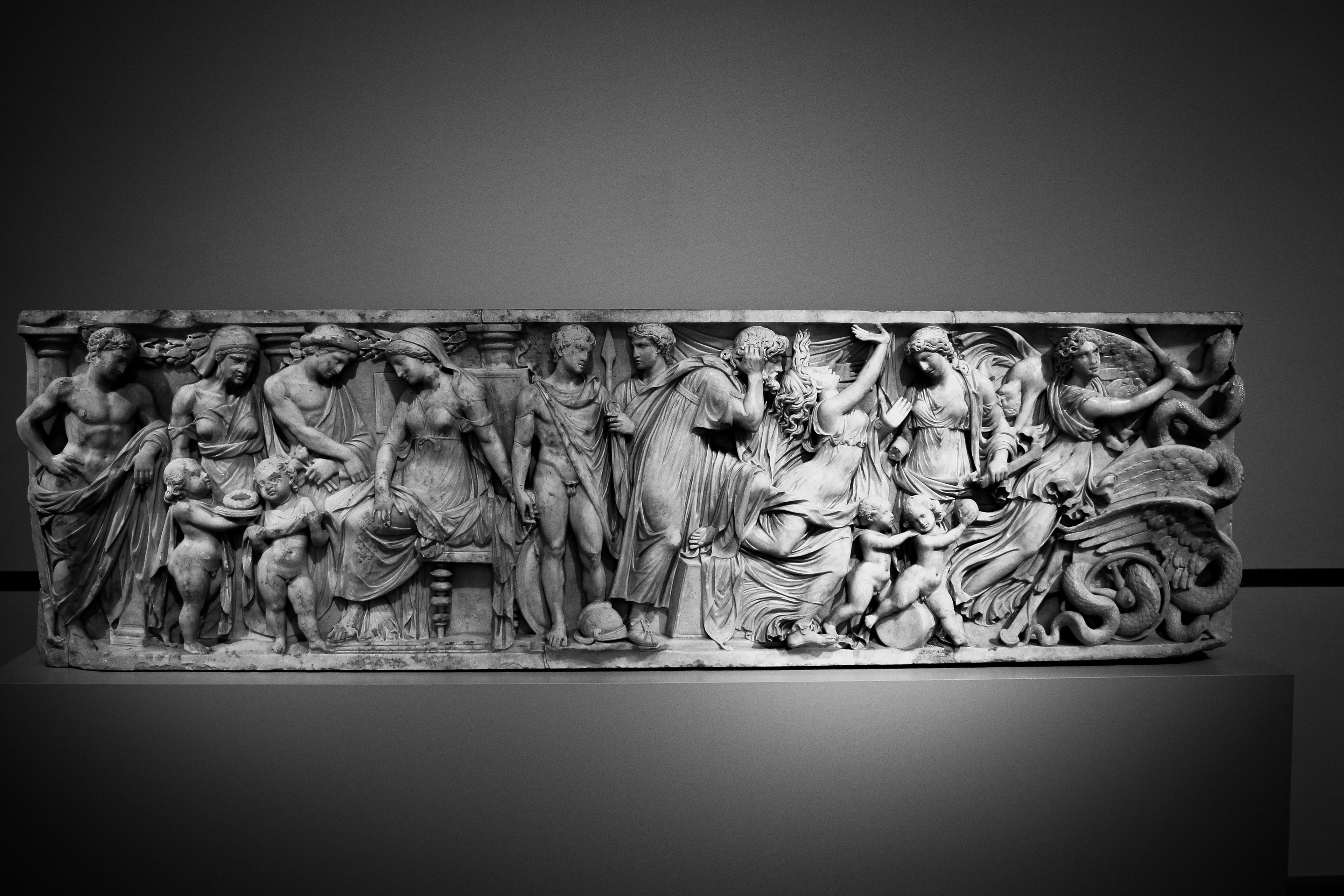
The Medea Sarcophagus in Berlin’s Altes Museum is 227 centimeters long and 65 centimeters high, carved from white marble in Rome around 140–150 AD, found near the Porta San Lorenzo on the city’s eastern edge. It is one of the finest examples of Roman mythological sarcophagus relief in any collection, and it depicts, in four continuous scenes reading left to right, the story of a woman who poisoned her rival, murdered her own children, and escaped in a dragon-drawn chariot to avoid the consequences. This is what a wealthy Roman family chose to carve on the box that would hold someone’s bones. The choice is not self-evidently logical. Making sense of it requires understanding something about how Rome thought about death that is not immediately obvious from the surface of the stone.
The narrative is from Euripides. Medea, the foreign sorceress who had helped Jason win the Golden Fleece and borne him two sons, discovers that he intends to abandon her for a politically advantageous marriage to Creusa, princess of Corinth. Her response is systematic and catastrophic. At the left of the relief, her children deliver the wedding gift — a poisoned garment and diadem — to Creusa, who receives them attended by her household. The gift’s effect occupies the center-left: Creusa in agony as the poison burns through her skin. The emotional center of the relief is Medea herself, shown in the grip of the decision — hand raised, children at her feet, her expression caught in the impossible moment between maternal love and the terrible logic of revenge. At the far right she escapes in the winged serpent chariot, the children’s bodies with her, Jason left with nothing.
Why this story on a coffin? The question is worth asking precisely because the modern instinct runs in the opposite direction — toward consolation, toward images of peace, reunion, and rest. Roman mythological sarcophagi systematically chose something else: violence, tragedy, transformation, and the extreme limit of human experience. Meleager’s death hunt. Achilles on Skyros. The labors of Hercules. Orestes pursued by the Furies. Niobe watching her children die. Endymion’s eternal sleep. The stories that recur on Roman burial monuments are stories of mortality at its most concentrated — of people destroyed by fate, by their own nature, by divine indifference, by the consequences of choices that could not be unmade. The dead person’s family commissioned these images, paid for them, placed them in the tomb. They knew what they were buying.
The explanation lies in a Roman understanding of myth that was philosophical before it was decorative. For educated Romans of the second century AD — the period that produced the majority of the finest mythological sarcophagi — Greek mythology was not primarily entertainment or religious doctrine but a repertoire of human situations refined by centuries of literary and philosophical treatment into something approaching universality. The myth of Medea was not a strange foreign story; it was a formulation of questions about betrayal, passion, justice, and the limits of human agency that Euripides had made definitive and that Roman literary culture had absorbed completely. Placing it on a sarcophagus was placing a philosophical argument about human experience at the site where human experience ended — a meditation on what life contained and what death resolved, or did not.
The Stoic and Platonic traditions that shaped educated Roman thought in the second century both provided frameworks within which violent mythological narrative made sense as funerary imagery. The Stoics taught that passion — irrational emotion overwhelming rational control — was the source of human misery, and Medea was the mythological instance of passion taken to its absolute limit. Her infanticide was not presented by Euripides or by the sarcophagus sculptor as simply monstrous; it was presented as the endpoint of a process that began with betrayal and continued through grief and rage to a conclusion that the rational self could not endorse but that the passionate self made inevitable. Placing this story on a burial monument was placing a warning and a diagnosis simultaneously: this is what unchecked passion does; this is the human capacity for self-destruction that death has now placed beyond further harm.
The Platonic contribution was different and in some ways more hopeful. Plato’s account of the soul — imprisoned in the body during life, released at death to its true existence — made the moment of death a threshold rather than an ending, and mythological stories of transformation became appropriate for funerary contexts precisely because transformation was what death was. Medea’s escape in the dragon chariot is not merely narrative convenience; it is metamorphosis, the passage from one state to another by supernatural means, which maps onto the soul’s departure from the body with enough precision to have been chosen deliberately. The mythology did not describe the afterlife literally. It described the structure of the transition, and that was sufficient for the purpose.
The quality of execution on the Medea Sarcophagus is extraordinary even by the standards of second-century Roman relief, which was producing some of the most technically accomplished sculpture in the Western tradition. The figures are carved in high relief that approaches full three-dimensionality in the foreground elements, with subsidiary figures receding into progressively lower relief behind them. The compositional problem of narrating four sequential scenes across a single continuous surface without visual confusion is solved through the strategic placement of architectural elements — the column at the left, the drapery that marks the central transition — and through the varying density of figures, which slows the eye at the emotionally significant moments and accelerates it through the connective tissue. Whoever carved this had thought carefully about how a viewer would read the surface from left to right and had designed accordingly.
The person whose remains this sarcophagus held is unknown. The monument was found without inscription identifying the deceased, which was not unusual — inscriptions were sometimes painted rather than carved, and have not survived. What survives is the choice: Medea rather than pastoral scenes, violent tragedy rather than peaceful sleep, the full complexity of human passion and its consequences rather than the comforting fiction that death was merely rest. Whoever commissioned this wanted the person they buried to be accompanied by one of the most demanding stories in the Greek repertoire, rendered at a level of craft that announced the family’s wealth and education simultaneously.
The Roman sarcophagus tradition lasted roughly from the second to the fourth century AD, ending as Christianity’s rising influence shifted funerary theology toward resurrection imagery and away from the pagan mythological repertoire. The transition was not abrupt — some Christian sarcophagi retained mythological elements in hybrid forms — but the direction was clear. The stories of Medea and Meleager gave way to stories of Jonah and Daniel, and the question that funerary imagery was asked to address changed from the nature of human passion to the promise of divine salvation. Both traditions were using narrative to make death manageable. They disagreed about which narratives did the work.
The Medea Sarcophagus predates that transition by two centuries and belongs fully to the pagan tradition at its most intellectually serious. It does not offer comfort. It offers recognition — the acknowledgment that human experience at its most intense is exactly what the myths describe, and that the person who has died was subject to everything those myths contain. That is a more honest form of mourning than consolation, and possibly a more durable one. The marble has lasted nearly two thousand years. The recognition it encodes has lasted longer.