Trajan's Column: Rome's Greatest Comic Strip
In the Cast Courts of the Victoria and Albert Museum in London, two enormous plaster columns rise through the full height of the room, split at the midpoint because no single gallery space in Victorian London was tall enough to accommodate the complete original. Red walls, a cast-iron skylight, medieval tomb effigies on the floor below, the Column of Marcus Aurelius visible behind — it is one of the stranger and more magnificent rooms in any museum in the world, and the centerpiece is a reproduction. The V&A made these casts of Trajan’s Column in the 1860s at the request of Pope Pius IX and Queen Victoria, who both wanted to study the reliefs without traveling to Rome. The decision proved more consequential than either of them anticipated. The original column, standing since 113 AD in Trajan’s Forum in Rome, has weathered continuously for nineteen centuries. The Victorian plaster casts now preserve detail that the stone in Rome has since lost. The reproduction is, in some respects, more legible than the original.
Trajan’s Column was completed in 113 AD to commemorate the two Dacian Wars of 101–102 and 105–106 AD — the campaigns that brought the gold and silver of Dacia into the Roman treasury and funded the building program of which the column itself was a part. It stands approximately 30 meters high on a base that served as Trajan’s tomb, topped by a statue that was originally of Trajan himself and replaced by a bronze of St. Peter in 1588, where it remains. The column’s shaft is hollow — an internal spiral staircase of 185 steps allowed access to a viewing platform at the top — and its exterior is covered by a continuous spiral frieze running from base to capital, approximately 200 meters long if unrolled, containing roughly 2,500 carved figures depicting the two campaigns in sequential narrative.
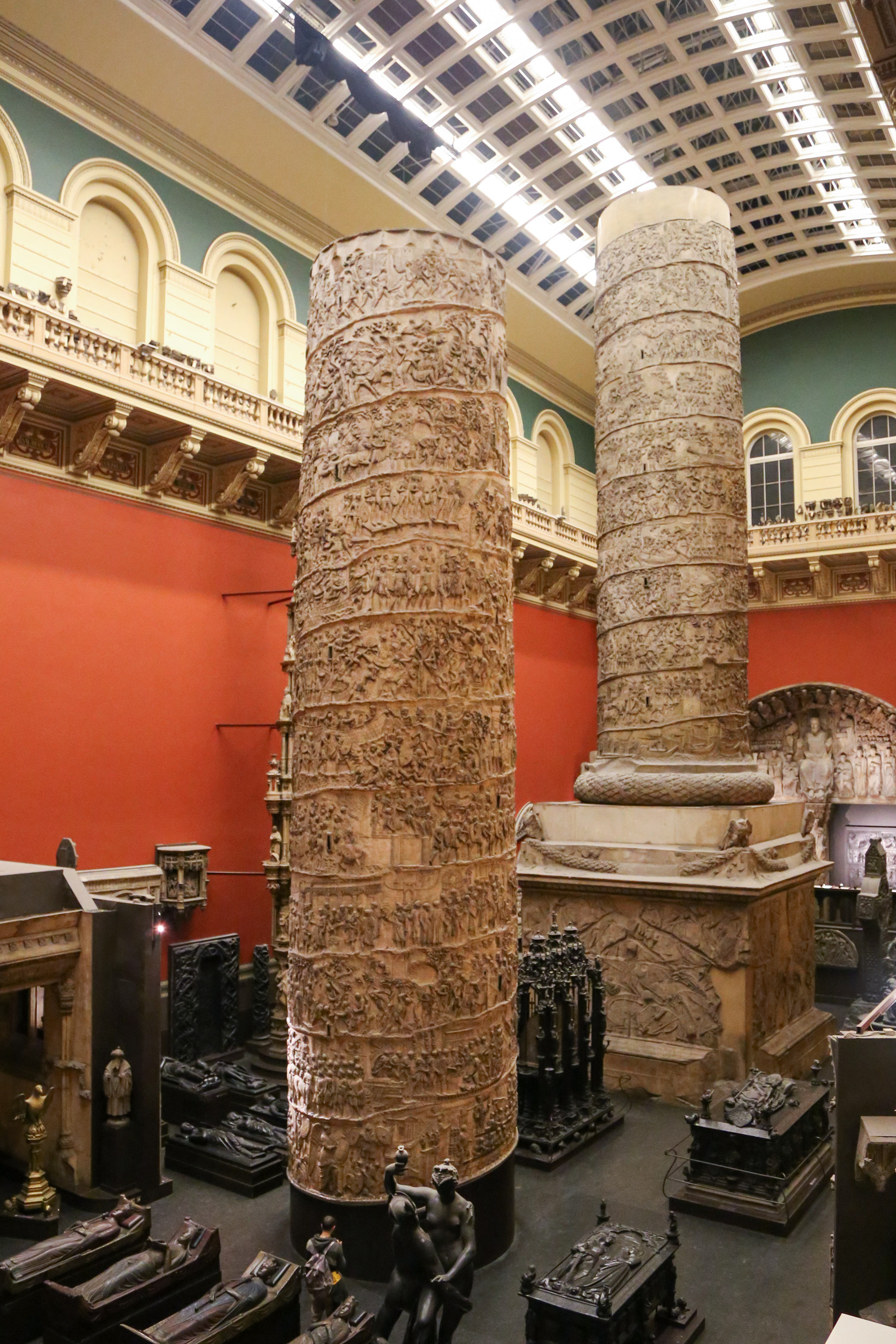
The comic strip comparison is not frivolous. The frieze shares with sequential visual narrative the fundamental challenge of telling a story across a continuous surface without the text that normally organizes the reader’s attention. The solution the Column’s sculptors developed was sophisticated and consistent: scenes are separated by trees, by architectural elements, or by the figure of the goddess Victory writing on a shield — a visual chapter break — while within scenes the narrative reads left to right and figures are scaled by importance rather than by perspective. Trajan appears over fifty times across the frieze, always identifiable by his position and his dress, the organizing presence that gives the sprawling campaign its coherence. The Roman soldiers build camps, cross rivers on pontoon bridges, receive barbarian delegations, haul supplies, attend sacrifices, assault fortifications, and fight in pitched engagements. The Dacians defend, retreat, submit, and die. Everything is shown. Nothing is captioned.
The decision to show everything — including the logistics — distinguishes Trajan’s Column from the standard conventions of Roman military commemoration. Most victory monuments concentrated on the moments of triumph: the battle, the submission of the enemy, the procession of captives. The Column shows those moments too, but it also shows the Roman army building the Danube bridge designed by Apollodorus of Damascus, constructing fortified camps on the march, moving artillery into position, and conducting the medical treatment of wounded soldiers. These are not heroic images in any conventional sense. They are operational images — documentation of the Roman military system functioning at its most organized and most competent. The Column is a monument to Roman administrative and engineering capacity as much as to Roman military courage.
The frieze’s original appearance was different from what the weathered stone or the plaster casts now show. The relief was painted — red, blue, green, and gold applied to differentiate figures from backgrounds and to clarify details that the stone alone would not have resolved at the Column’s height. The painting is entirely gone, stripped by centuries of exposure, and the monochrome stone gives the frieze a uniformity of tone that would have been absent when the Column was new. Reconstructions based on analysis of the surviving pigment traces suggest a polychrome surface considerably more legible from ground level than the current stone, which at its upper registers requires binoculars to read in any detail. The Column was always partly a symbolic object rather than a purely informational one — its height announced ambition before its reliefs announced content — but it was also designed to be looked at, and the painting was part of that design.
The question of who could actually read the narrative is the Column’s persistent interpretive problem. The frieze begins at a height accessible to a viewer standing at the base; the lowest registers can be examined at close range without optical assistance. As the spiral ascends, the figures become progressively less accessible to the naked eye, the upper thirds of the Column effectively invisible to anyone standing at ground level without magnification. Scholars have debated whether this means the upper narrative was never intended for ground-level reading — whether it was addressed to the gods, or to viewers on the surrounding buildings of Trajan’s Forum that would have been at roughly eye level with the middle registers — or whether the Column’s function was primarily symbolic and the complete narrative was a theological gesture of completeness rather than a practical visual program. The V&A casts resolve this problem by putting the entire frieze at eye level, which is why the Victorian scholars who made the casts could read the narrative in sequences that Roman viewers at ground level never could.
Apollodorus of Damascus, who designed the Column and whose engineering work on the Dacian campaigns is itself depicted in the frieze — the great Danube bridge is shown in detail sufficient to have generated architectural analysis — was later executed by Hadrian, reputedly after criticizing Hadrian’s own architectural designs. The Column that Apollodorus built outlasted both Trajan who commissioned it and Hadrian who killed its architect, which is the kind of historical irony that the Column’s subsequent nineteen centuries of survival make increasingly pointed with each passing century.
The cast courts of the V&A were built specifically to house the growing collection of architectural casts assembled through the second half of the nineteenth century — a period when European museums were developing the ambition to make the world’s great monuments accessible to populations that could not travel to see them. The project was collaborative and international: the plaster cast of Trajan’s Column required the Pope’s cooperation, diplomatic negotiation, and the physical work of casting sections of the original in Rome before transport to London. The ambition was educational and the result was transformative, because the casts preserved states of the originals that time has since eroded.
Standing at the base of the V&A casts, looking up through the room’s full height at the spiral narrative of the Dacian Wars, you are looking at something closer to what Trajan’s contemporaries saw than anything visible in Rome today. The column in the forum is more authentic in every documentary sense — it has stood on the same spot for nineteen centuries, Trajan’s ashes were in its base, the Senate and the Roman people erected it in that specific place as part of a specific political program. The cast in London is plaster, Victorian, and split in two to fit the room. It is also more legible. Both things are true, and the tension between them is a reasonable summary of what happens to Rome over two thousand years: the original weathers, the copies preserve, and somewhere in the gap between them the actual thing that was made is still recoverable if you look carefully enough.