The Fayum Portraits: Faces from the Edge of the Roman World
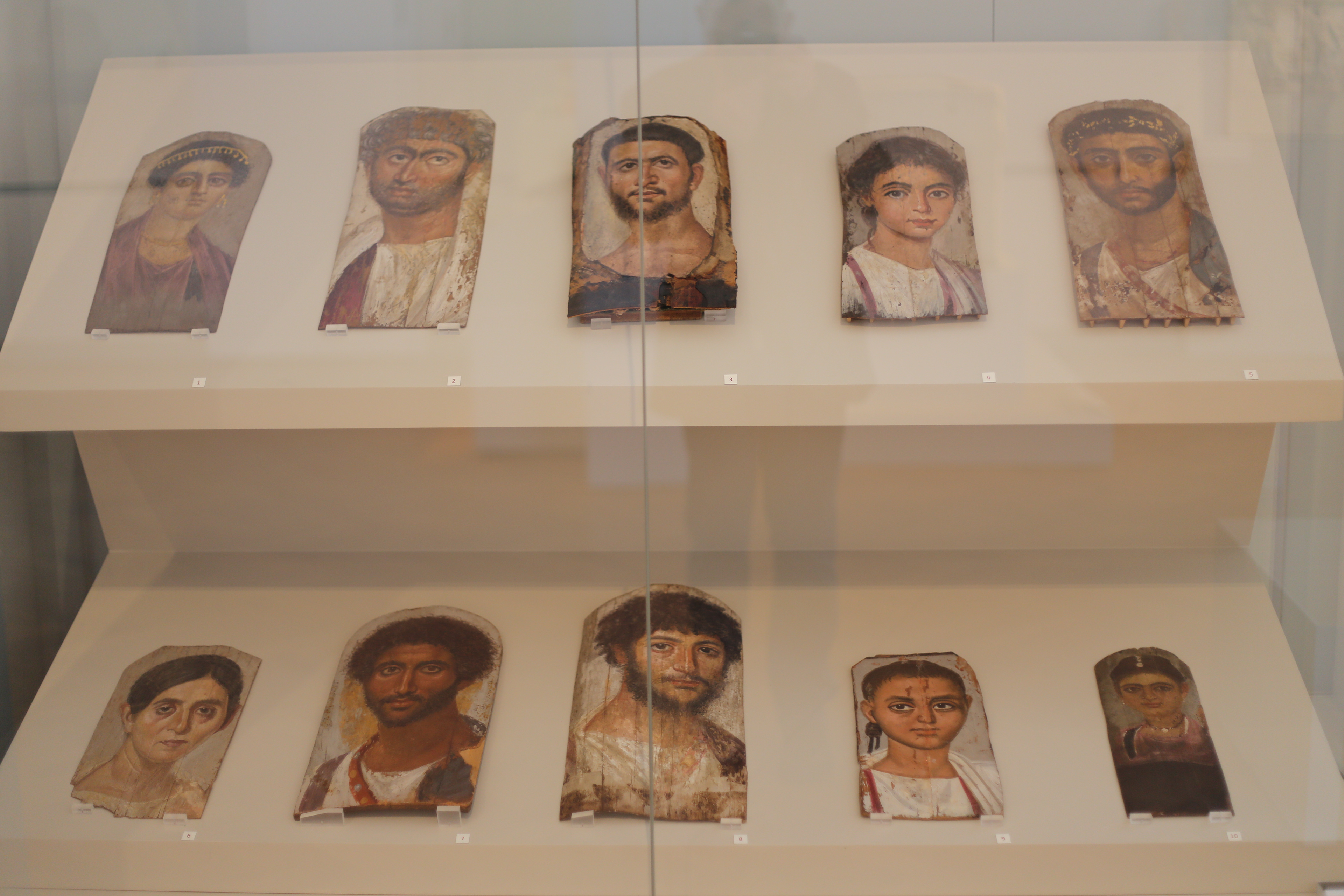
In a case in the Altes Museum in Berlin, ten painted wooden panels are arranged across two shelves: five on the upper row, five below. They show men, women, and children. The youngest is perhaps eight or nine years old. The oldest appears to be in his fifties, though age is difficult to assess with confidence from encaustic wax portraits of the first through third centuries AD. What is not difficult to assess is the gaze. Every one of these faces looks directly out of the panel, directly at whoever is standing in front of the case, with the same frontal directness. They were painted to look at you. Eighteen centuries later they still do, and the effect has not diminished.
These are Fayum mummy portraits, from Roman Egypt, and they are the most direct surviving example of Roman panel painting tradition applied to private rather than imperial subjects. They are also among the most affecting objects from the ancient world in any collection — not because of their technical virtuosity, though the technique is remarkable, but because of what they were made for. Each panel was placed over the face of a wrapped mummy, fitted to the body, inserted into the linen bandaging so that the painted face was visible. The dead person looked out from their own burial. The portrait was not a memorial left behind for the living; it was placed with the body, for whatever came next.
The technical process was encaustic — pigment mixed with hot beeswax and applied to a wooden panel with a heated tool — or occasionally tempera, the same water-based medium used in the Severan Tondo. Encaustic produces a surface with unusual optical depth: the wax layers build luminosity in a way that flat tempera cannot match, and the portraits’ skin tones have a warmth that is partly the pigment and partly the wax’s translucence. The technique was Greek in origin, standard in Hellenistic panel painting, and almost entirely lost from the archaeological record except for these Egyptian survivals. Roman Egypt’s dry climate preserved objects that the Mediterranean’s humidity destroyed everywhere else. The Fayum portraits exist because Egypt did not rot them.
The social range visible in the Berlin case alone makes clear that the practice extended well across the provincial middle class. The women wear elaborate jewelry — gold earrings, necklaces, diadems — that represented genuine wealth translated into portraiture. The men’s beard styles follow Roman imperial fashion closely enough to serve as approximate dating evidence: the clean-shaven faces belong to the earlier imperial period, the beards to the Hadrianic fashion that spread after the 120s AD and persisted through the Severan period. The children are painted with the same direct gaze as the adults, the same frontal presentation, the same assumption of individual identity worth recording. Roman Egypt, unlike Roman Italy, buried its children in the same tradition as its adults and left us their faces.
The cultural fusion the portraits represent is unlike anything else from the Roman world. The commission was from Greek-speaking provincial families — the Fayum region, the fertile depression southwest of Cairo, had been settled by Greek veterans since the Ptolemaic period — who had absorbed Roman portrait conventions while continuing Egyptian mummification practice. The result is an object that belongs to three traditions simultaneously: Greek in its artistic vocabulary, Roman in its portrait style and its social function as an assertion of individual identity, Egyptian in its funerary application and its implicit theology of bodily preservation for the afterlife. No single tradition is primary. The synthesis is the point.
The names recorded in inscriptions on some portraits are similarly hybrid: Greek names most common, Egyptian names appearing, Latin names found among those with military connections. The people in the Fayum portraits inhabited a world where cultural identity was not singular and where the materials available for self-presentation were drawn from multiple traditions without apparent anxiety about consistency. The woman in the upper left of the Berlin case wears a diadem in the Roman fashion; her jewelry is provincial but her gaze is the same direct confrontational look that Roman portrait busts standardized as the appropriate expression for persons of standing. She is claiming standing. The portrait is the instrument of that claim.
The largest collections of Fayum portraits are in London, Berlin, Cairo, and Vienna, with significant holdings scattered across European and American museums following the excavations and purchases of the late nineteenth century — a period when the portraits were being extracted from burial sites with varying degrees of archaeological rigor by dealers who understood their market value before scholars had fully assessed their historical significance. The Altes Museum’s collection is among the finest in Europe, selected across a range of periods, techniques, and social types that makes the case feel like a cross-section of provincial Roman Egyptian society rather than a selection of exceptional objects.
The child in the lower right of the Berlin case is the one that stops most visitors longest. The face is young enough to be unformed in the way children’s faces are before experience has settled into them, and the gaze has the same unwavering directness as the adults despite the age. Someone painted this face from life, or from recent memory, which means this child sat for a portrait at some point before dying — the portrait was either made in anticipation of death or commissioned immediately after, a common practice given the short time before mummification was required by the Egyptian climate. Either way, someone looked at this child carefully enough to record the specific shape of their eyes, the particular set of their mouth, the quality of their direct gaze. The portrait is what remains of that looking.
What the Fayum portraits demonstrate collectively, beyond their individual fascination, is the reach of the Roman practice of individual portraiture into a provincial society that combined it with its own funerary traditions and produced something new. Rome did not create the Fayum portraits — the technique was Greek, the mummification was Egyptian, the social aspiration was provincial — but the Roman imperial framework created the conditions in which this particular synthesis was possible: a commercially integrated Mediterranean world where painting techniques, portrait conventions, and burial practices could travel, combine, and produce objects that none of the contributing traditions would have made alone.
They look at you from the case, each of them, with the patience of people who have been doing this for eighteen centuries and intend to continue. The wax holds the pigment. The pigment holds the gaze. The gaze holds everything else.