Rome and the Lion: Power, Spectacle, and the Edge of Empire
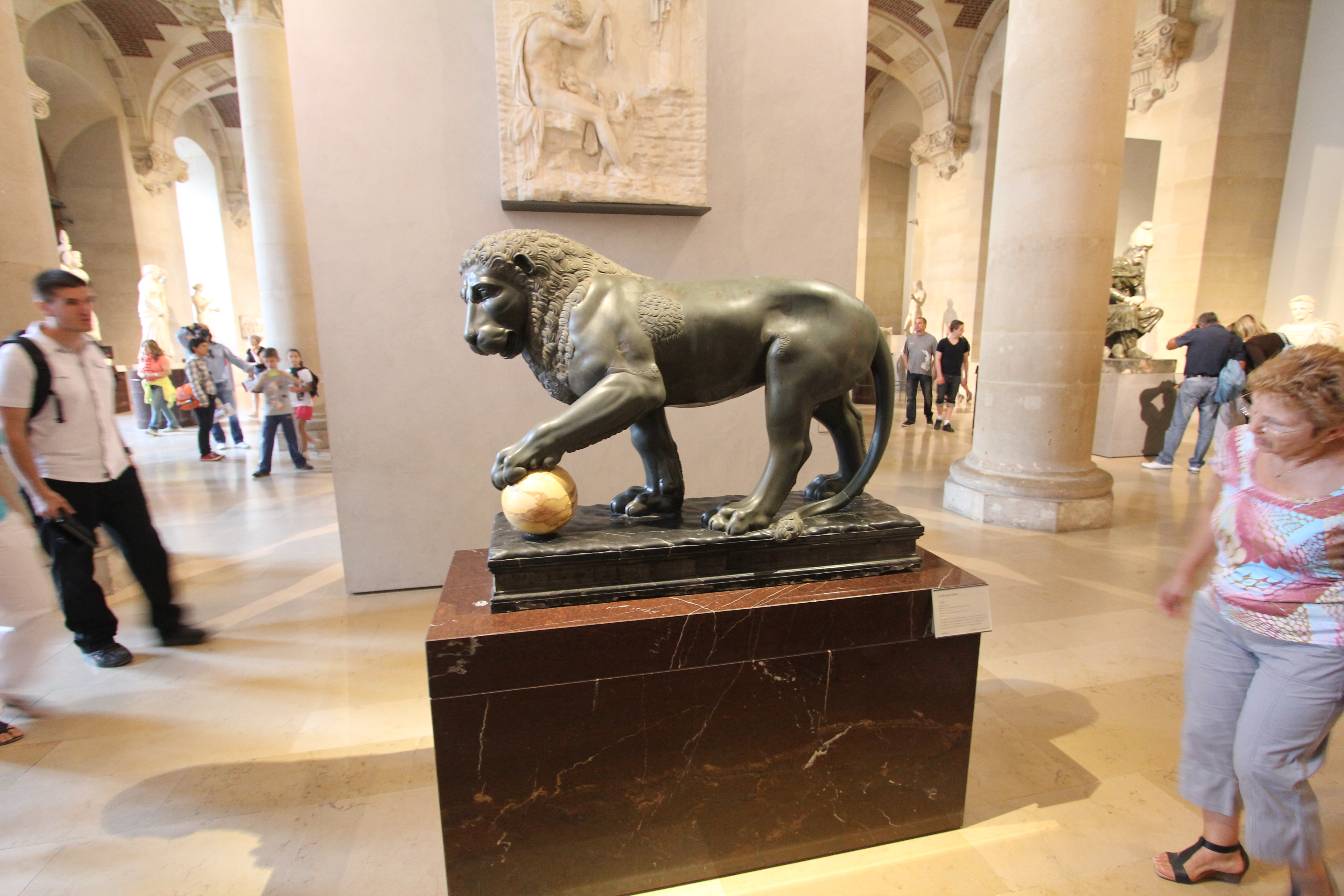
The bronze is Roman, from the Albani Collection, and it sits now in the Louvre’s antiquities hall on a plinth of dark marble, moving through nothing. The lion has one paw resting on a sphere — the globe, the world, the totality of things worth possessing — and the posture is neither aggressive nor relaxed. It is the posture of ownership. The sphere is already subdued. The question of whether anything else needs subduing remains open. This is not a lion that has just won. This is a lion that expects to win.
The sphere beneath the paw is the key detail. It appears across Roman imperial iconography in different contexts and under different paws — the emperor’s, the goddess Victoria’s, Jupiter’s — always carrying the same meaning: dominion over the known world, expressed as a physical object small enough to be held or pinned. Combined with the lion, the image compounds two of Rome’s most persistent symbolic obsessions into a single compact statement. The lion stood for force, courage, and the outer limit of the natural world. The globe stood for Rome’s claim to have made that limit its own. Together they said something the Romans found worth saying in bronze, in marble, in mosaic, and in the flesh of actual lions dying in actual arenas before actual crowds across three centuries of imperial spectacle.
Rome’s relationship with lions was practical before it was symbolic. The animals came from North Africa, from the eastern provinces, from the edges of territories that Roman traders reached beyond Roman administration. Procuring them required networks of hunters, trappers, and middlemen operating in regions where Roman political authority was thin or absent — the Libyan interior, the Atlas Mountains, the fringes of sub-Saharan Africa, the forests of Syria and Mesopotamia. The logistics of capturing adult lions without killing them, keeping them alive during transport across hundreds of kilometers of difficult terrain, delivering them to coastal ports, shipping them across the Mediterranean, and holding them in adequate conditions until the games required them were considerable. The cost was commensurate. When an emperor or a magistrate funded a venatio — an animal hunt in the arena — and announced that it would feature lions, he was advertising not only the spectacle but the reach of his resources.
The venationes were morning events, preceding the gladiatorial bouts of the afternoon. Trained animal fighters — the bestiarii — faced the imported beasts in the arena in combinations that ranged from single combat to mass hunts involving dozens of animals simultaneously. The variety and rarity of the animals on display was itself a demonstration of imperial geography: lions and leopards from Africa, bears from the northern provinces, rhinoceroses and hippopotamuses from equatorial Africa, tigers from Asia, crocodiles from the Nile. To see a tiger in the arena in Rome was to understand, viscerally, how far Roman commercial networks extended into territory that Roman legions had never reached. The animal was the evidence.
The numbers were extraordinary. The inaugural games of the Colosseum in 80 AD reportedly killed five thousand animals over a hundred days. Trajan’s Dacian triumph games in 107 AD involved eleven thousand animals across the entire sequence of events. These figures from ancient sources are difficult to verify and probably rounded, but the archaeological evidence from the Colosseum’s hypogeum — the underground infrastructure beneath the arena floor — confirms the industrial scale of animal management: holding cages, lifting mechanisms, corridor systems designed to move large and dangerous animals from underground storage to arena surface without exposing handlers to unnecessary risk. The Colosseum was not merely a performance space. It was a logistics operation.
The symbolic weight of lions in Roman culture extended well beyond the arena. Hercules, the mythological figure most closely associated with Roman imperial virtue, wore the Nemean lion’s skin as his defining attribute — the animal he had killed with his bare hands as the first of his labors, whose impenetrable hide became his armor. The connection between lion-killing and supreme masculine achievement was Greek before it was Roman, but Rome absorbed and amplified it. Emperors who wanted to project particular vigor had themselves depicted hunting lions; Commodus, whose enthusiastic participation in arena combat as a gladiator was one of the things his contemporaries found most alarming about him, also hunted lions in the arena and had himself portrayed as the New Hercules. The iconographic chain was explicit: Hercules killed the lion, Rome killed everything, the emperor was the embodiment of both.
The lion’s geographical association reinforced its symbolic function. It came from the places at the edge of the known world, the places where Roman authority thinned out and became uncertain. Bringing it to Rome and killing it in the arena in front of a hundred thousand people was a performance of the proposition that nothing beyond Rome’s reach existed — that the edge of the world had been found and found manageable. Whether anyone in the crowd believed this proposition literally is unlikely. What they were participating in was something more like civic ritual than factual assertion: the collective rehearsal of Rome’s claim to universal dominion, repeated until it felt true.
The Albani lion’s sphere makes the claim in miniature. The animal that represented the world’s wild periphery holds the world’s civilized center under its paw, and the combination is Rome’s entire imperial self-image in a single bronze object: the force that could reach to the edges of the known world, bring back what it found there, and place it beneath its control. The sphere does not struggle. The lion does not strain. The dominion is simply the condition of things, expressed in the permanent stillness of metal that has outlasted the empire that commissioned it by two thousand years.
What Rome’s lion obsession ultimately reveals is the connection between spectacle and geography that ran through everything the empire did in public. The arena was a map as much as a theater. Every exotic animal that died in it was a data point about how far Roman commercial networks extended, how much wealth the emperor could mobilize, how completely the world beyond the city walls had been made available for Roman consumption. The bronze in the Louvre is the same argument made for a private collection rather than a public crowd — the same lion, the same globe, the same claim, scaled down to the size of a room. The claim was the same regardless of scale. Rome made it in every medium available to it, and made it for long enough that it started to seem simply true.