The Gladiator: What the Arena Actually Was
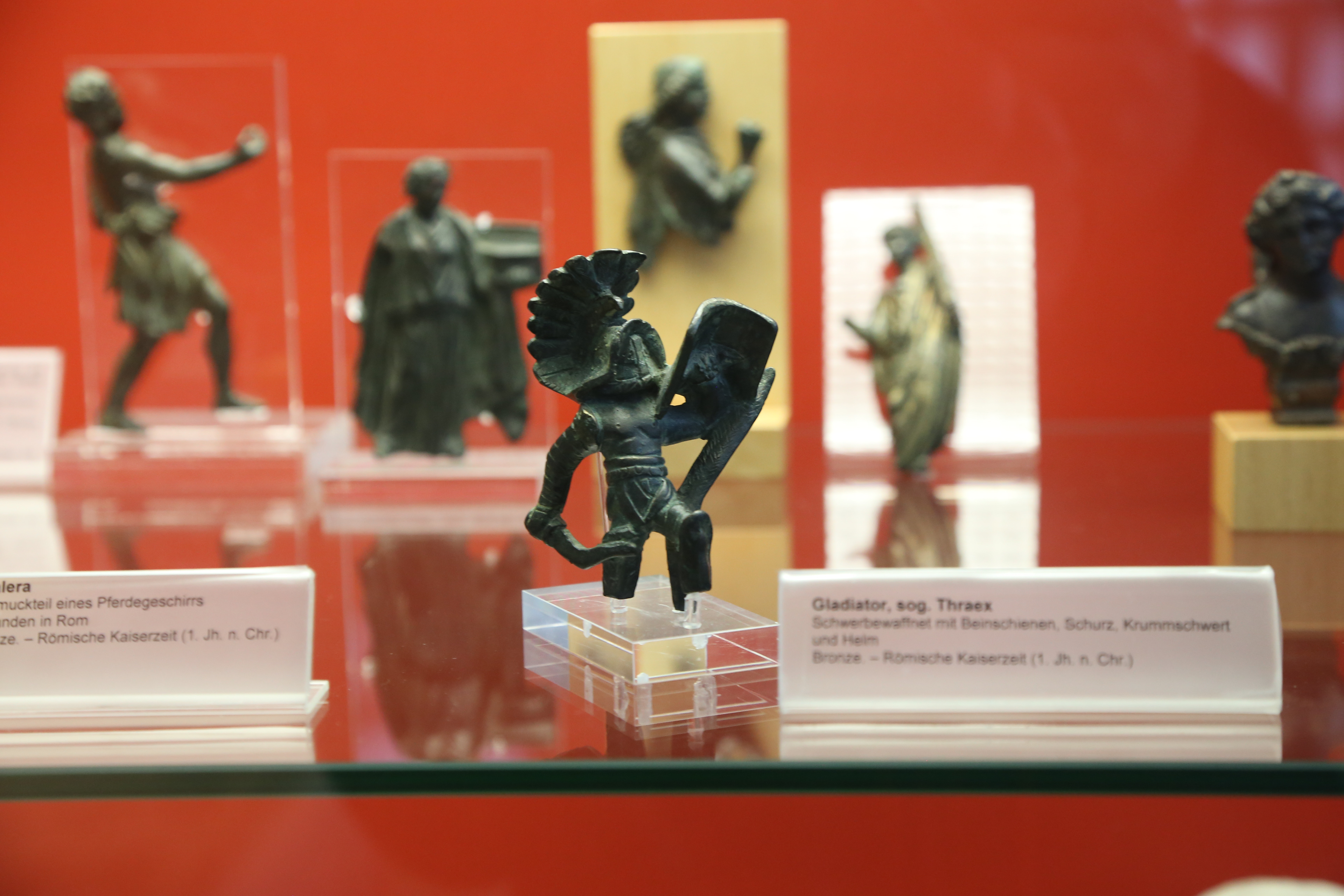
The bronze is perhaps eight centimeters tall and has been in Hannover’s Museum August Kestner for longer than most living people can account for. It shows a Thracian gladiator — the Thraex type, one of the most popular and most recognizable in the Roman arena — in full equipment: the curved sica sword, the small rectangular shield, the elaborate crested helmet with its full-face visor, the greaves protecting both legs. The label reads simply Gladiator, sog. Thraex, Roman Imperial period, first century AD. It sits on a glass shelf among other Roman bronzes, modest in scale, extraordinary in specificity. Whoever made this knew exactly what a Thraex carried and wore. They made this figure because there was a market for it. That market is itself part of the story.
Roman gladiators were merchandise before they were anything else. The small bronzes, the terracotta lamps, the mosaic portraits, the graffiti endorsements scratched on walls across Pompeii — the gladiator generated commercial products at a scale that only genuine celebrity produces. A successful fighter’s name was known across the city and beyond it; his upcoming bouts were advertised on painted notices; his image appeared on domestic objects that people bought and used in their homes. The Thraex figurine in Hannover was not a museum piece when it was made. It was a consumer product, purchased by someone who followed the games closely enough to want a three-dimensional representation of a specific fighting type sitting on a shelf.
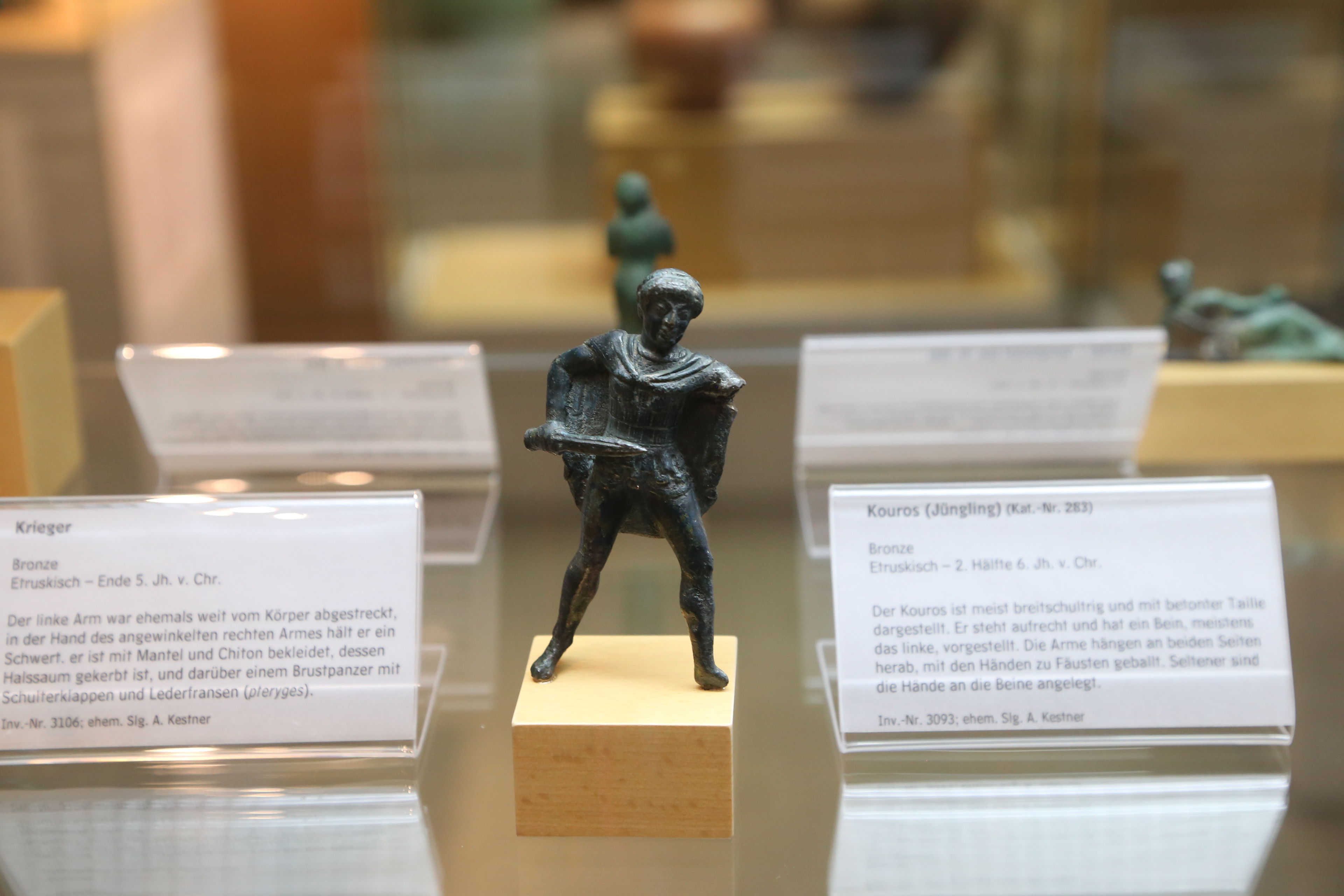
The origins of gladiatorial combat are Etruscan, and the same museum holds the evidence. Among its Etruscan bronzes is a warrior figurine from the late fifth century BC — the Krieger, labeled as Etruscan, dressed in the military equipment of a warrior culture that preceded Rome in central Italy and that transmitted to Rome an enormous quantity of its political vocabulary, religious practice, and military custom. The gladiatorial combats that Romans eventually staged in arenas across the empire began as funerary rites in Etruscan practice: armed combat performed at the graveside of important men, the blood shed understood as nourishment for the dead. Rome inherited the practice, stripped it of its explicit funerary context, and over several centuries transformed it into the most elaborate and commercially sophisticated entertainment industry the ancient world produced.
The transformation took centuries and was not linear. The first recorded gladiatorial combat in Rome dates to 264 BC, staged at a funeral by the sons of Decimus Junius Brutus Pera in honor of their father — three pairs of fighters, in the Forum Boarium, as a private funerary offering. By the late Republic the games had detached from individual funerals entirely and become public events funded by magistrates seeking political popularity. By the early Empire they were imperial productions managed by the state, staged in permanent stone venues, involving hundreds of fighters, and generating a commercial infrastructure of training schools, equipment manufacturers, medical specialists, and marketing that functioned as an industry in the modern sense.
The gladiatorial types — and there were many, each with its own equipment, fighting style, and conventional opponent — were not arbitrary categories but carefully developed combat systems optimized for spectacle. The Thraex, with his curved blade and small shield, was conventionally matched against the murmillo, a heavier fighter with a larger shield and straight sword. The retiarius, armed with trident and net, was matched against the secutus, a pursuer whose smooth helmet with small eye-holes was designed to give the net nowhere to catch. Each pairing was a tactical argument — light against heavy, mobility against defense, reach against protection — and the crowd understood the dynamics well enough to have preferences, to recognize when a fighter was performing at his best, and to argue about the result afterward.
The economics were significant and frequently misunderstood. Gladiators were expensive assets. Training them took months; feeding and housing them during that training cost money; equipping them properly cost more. A gladiator who died in the arena represented the loss of a substantial investment. The ludus — the gladiatorial training school — was run by a lanista, a businessman whose interests were directly served by keeping his fighters alive and fighting. The death rate in the arena was real but substantially lower than popular culture implies; the ancient records that survive suggest that a well-matched bout between trained fighters more often ended in one man’s defeat and submission than in his death. The crowd’s decision — or the presiding magistrate’s, influenced by the crowd — determined whether the defeated fighter lived or died, and sparing a fighter who had performed well was both a display of generosity and a rational economic choice.
The men who fought were overwhelmingly slaves, condemned criminals, or volunteers who had signed away their legal rights in exchange for the training, housing, and pay that the ludus provided. Volunteers existed in meaningful numbers, which tells you something about the relative attractiveness of gladiatorial life compared to the alternatives available to men at the bottom of the Roman social structure. The gladiator who survived long enough to be good at his work occupied a peculiar social position: legally disgraced, civilly marginalized, personally famous, and potentially wealthy from prize money and gifts. Women who found them attractive were a recurring subject of moralizing comment from Roman writers who found the combination of social degradation and physical celebrity difficult to process elegantly.
The emperor’s relationship with the arena was political as much as recreational. Games funded by the emperor demonstrated his generosity to the urban population in terms that were immediate and visceral. The emperor who attended in person, who responded to the crowd’s demonstrations, who granted or withheld mercy visibly, was performing an accountability that the principate’s constitutional structure did not otherwise require of him. Commodus’s decision to fight in the arena himself — as a gladiator, against opponents carefully selected not to threaten him seriously — generated the senatorial outrage that his other conduct had not fully produced, because it violated the categorical distinction between the man who watched and the men who performed. That distinction mattered more than the mortality risk, which in Commodus’s case was minimal.
The small Thraex in Hannover contains all of this — the commercial infrastructure, the specific technical vocabulary of gladiatorial types, the celebrity culture, the Etruscan origins transmitted through centuries of Roman development — compressed into eight centimeters of first-century bronze. Someone bought it because they knew what a Thraex was, because they had opinions about how the Thraex performed against the murmillo, because the arena was part of their imaginative world in the way that particular sports teams and their players are part of ours. The specific type matters. The equipment is accurate. The person who made it knew their audience, and the audience knew their gladiators. Two thousand years later the bronze sits under museum lights and the audience is us, still looking.