The Roman Grain Ship: How Rome Fed Itself Across the Sea
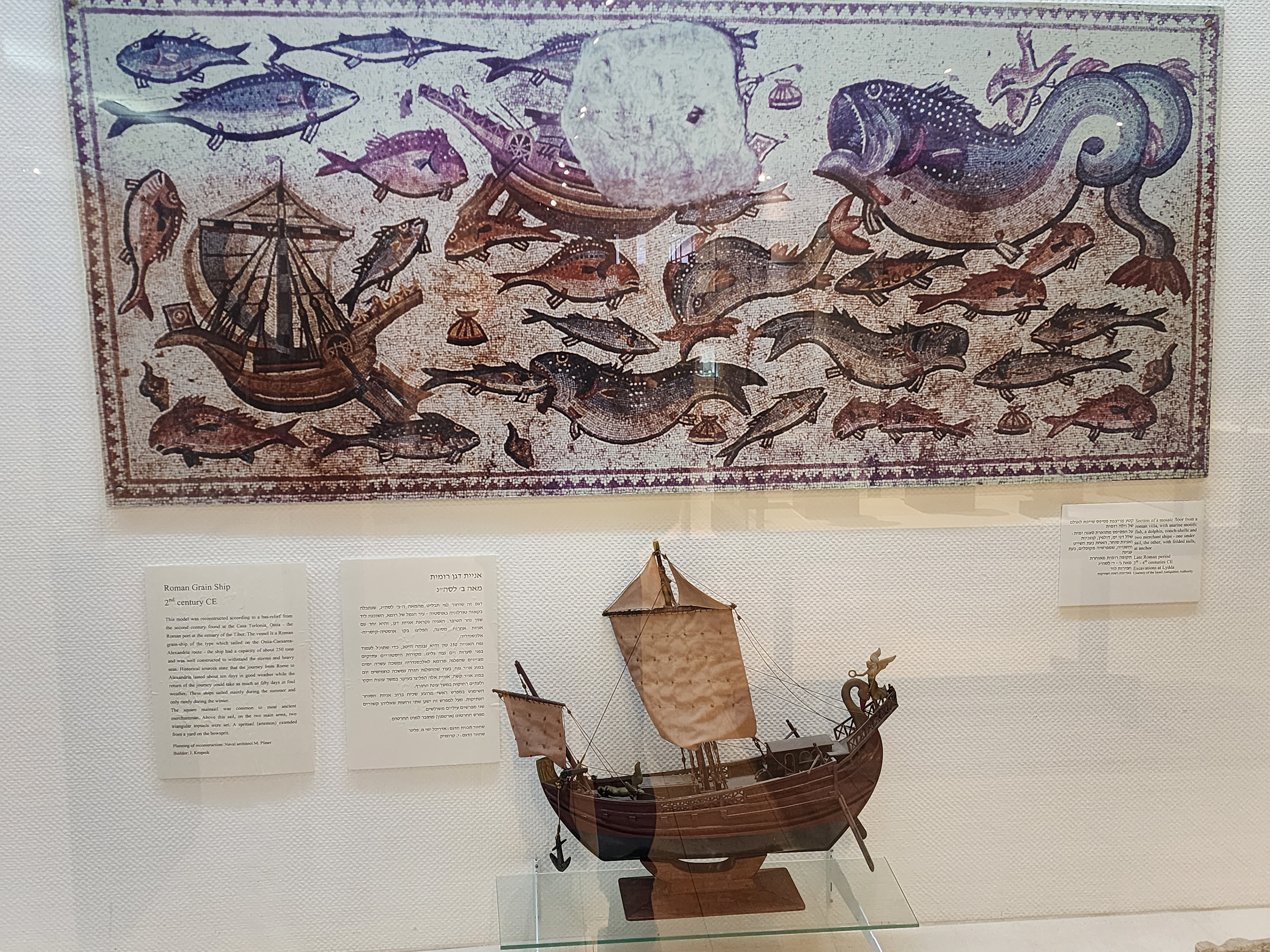
In the National Maritime Museum in Haifa, a reproduction of a Roman maritime mosaic hangs above a scale model of a Roman grain ship. The mosaic — a copy of the type found decorating the floors of maritime collegia and wealthy houses at Ostia and other Roman port cities — shows the sea as Romans imagined it: dense with fish and marine creatures, alive with the visual abundance that the Mediterranean provided, a merchant vessel moving through a world of tuna, dolphins, an octopus, a whale. The sea in Roman mosaic art is not threatening; it is productive, teeming, the source of food and commerce and the medium through which the empire connected its parts. Below the mosaic, the grain ship model shows the vessel that made this connection real: broad-hulled, square-sailed, designed not for speed but for capacity, the workhorse of the most important supply chain in the ancient world.
The model was reconstructed from a bas-relief found at the Grain Exchange in Ostia — the Roman port at the Tiber mouth — which depicted the vessel type that ran the Alexandria-to-Rome route. The label is specific: capacity approximately 250 tons, the journey from Alexandria in good weather approximately fifty days. The ship is not elegant. It is functional in the way that things optimized for a single purpose over generations of practical refinement tend to be functional: the broad beam that provides stability and cargo volume, the single large square sail that uses the prevailing winds without the complexity of multiple-mast rigging, the swan-neck sternpost that is simultaneously structural and decorative, the anchor visible at the bow. This ship existed to move grain, and its design solved that problem with the directness of a tool.
Rome at its height had a population of somewhere between half a million and a million people. None of the agricultural land within practical distance of the city could feed this population. The grain that sustained it — wheat primarily, with some barley for the lower-quality distributions — came from Egypt and North Africa, crossing the Mediterranean in ships of this type in quantities that required a sustained maritime operation of considerable organizational complexity. The annona, the grain supply administration, was one of the most important functions of the imperial government, and its prefect — the praefectus annonae — was among the most consequential officials in the empire, controlling the logistics that determined whether the city ate or rioted.
The Egyptian route was the most significant. Alexandria — the largest grain-producing region in the Mediterranean world, sitting at the head of the Nile delta whose annual flood deposited the nutrient-rich silt that made Egyptian agriculture extraordinarily productive — shipped grain north and west across the Mediterranean in the summer sailing season, when the prevailing winds and the weather windows made the crossing manageable. The fifty-day voyage from Alexandria to Ostia cited in the museum label represents the upwind journey; the return, running before the northwesterly winds, was considerably faster. Fleets of grain ships made this crossing annually in numbers sufficient to supply the city’s requirements, and the loss of a season’s shipping to storm or piracy was a political crisis, not merely a logistical one.
The ships themselves were privately owned, contracted to the state through a system of incentives — tax exemptions, citizenship grants, legal privileges — that made grain shipping commercially attractive enough to sustain the fleet the annona required without direct state ownership. The shippers — the navicularii — formed one of the most important commercial classes in the empire, their collegia visible at Ostia’s Piazzale delle Corporazioni, where the mosaic emblems of shipping associations from Alexandria, Carthage, and other grain-producing regions advertised their services. The grain ship was the pivot point where imperial administration and private commerce met, each depending on the other, neither fully controlling the arrangement.
The physical challenges of the route were significant. The Mediterranean is not a forgiving sea in winter, when storms from the northwest could trap a fleet at Ostia or scatter it along the North African coast. The sailing season ran from May to October in its safe phase and from March to November with increased risk; winter voyages were attempted only under extreme necessity and at substantial loss. A grain ship caught in a winter storm on the run from Alexandria carried not just its cargo but the political stability of a city that could not absorb a supply disruption without disorder. The pressure on captains to make the crossing in marginal conditions was real, and the wrecks that maritime archaeology has recovered from the western Mediterranean attest to the frequency with which the calculation went wrong.
The cargo handling at Ostia required its own infrastructure. The grain ships were too large and too deep-drafted for the Tiber — the river that connected Ostia to Rome was navigable by the shallow-draft lighters that moved goods upstream, not by the broad-hulled merchantmen that had crossed the Mediterranean. The grain was transferred from the oceangoing vessels to the river barges at Ostia’s harbor — a process that required stevedores, measurement officials, quality inspectors, and the warehousing capacity to buffer the transfer when the river was running too fast or too slow for barge traffic. The mensores frumentarii — the grain measurers — verified weight and quality at transfer, their college at Ostia documented in inscriptions and their function in the legal records that regulated their activities.
The Roman grain ship is not a glamorous object. It lacks the speed and elegance of the trireme, the aggressive profile of the warship, the dramatic purpose of a vessel built for combat. It was a cargo carrier, designed to be loaded, sailed, unloaded, and loaded again, its operational life measured in crossings rather than in battles. But without it, Rome could not have been what it was. The empire’s military capacity, its administrative apparatus, its literary culture, its building programs — all of it rested on the logistical foundation of ships moving grain across the sea at sufficient scale and sufficient regularity to keep a city of half a million people fed. The mosaic above it shows the sea as Roman abundance. The model below shows the mechanism that converted that abundance into imperial possibility. Both are necessary to understand what Rome actually was.