The Met's Augustus Was Carved After He Died, and It Shows Him Half His Age
The head is over life-size, twelve inches on its own, and it broke away long ago from what was probably a seated statue of the emperor. The Met dates it to somewhere between 14 and 37 CE, which is the reign of Tiberius. Augustus was already dead when the sculptor started work. He had died in 14 CE at seventy-seven, after fifty-odd years at the centre of Roman public life, and the face on this marble belongs to a man around thirty.
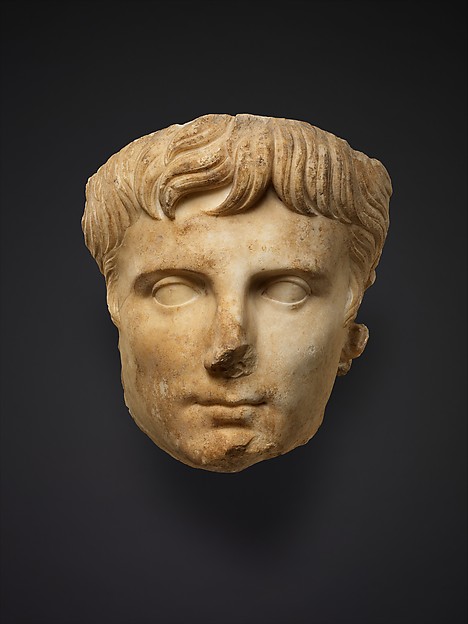
That is not sloppiness or a sculptor working from a bad description. Something over 250 portraits of Augustus survive, scattered from Spain to Syria, and none of them shows him old. Not one. A man who governed Rome into his late seventies left behind no official image of an aging face, across half a century of intensive production, in a culture that had spent the previous two hundred years treating old faces as the most prestigious thing you could put on a pedestal.
The Republic Wanted You to Look Ruined
Late Republican portraiture ran on verism, a style that pushed realism past flattery and into something close to cruelty. Senatorial portraits of the first century BCE give you receding hairlines, pouched eyes, furrows cut deep into the cheeks, necks going slack. Sitters were not enduring this. They were paying for it.
The logic was political. A Roman noble’s authority rested on auctoritas, an accumulated weight built from offices held, campaigns survived, and clients obliged, none of which a young man could possess. Aristocratic families kept wax imagines, ancestor masks, in the atrium and paraded them at funerals. A face lined by decades was a résumé rendered in stone. Looking worn meant looking qualified.
Augustus grew up inside that convention. He then abandoned it completely.
He Stopped Aging at About Thirty
The portrait type that dominates his reign is named after a statue found at Prima Porta, and it locks his appearance into a fixed scheme: calm features, smooth cheeks, no trace of strain, and a specific arrangement of locks above the forehead that scholars still use to sort copies into families. The hair is the tell. Those locks fall in a pattern precise enough to function as a signature, which means workshops across the empire were reproducing an approved model rather than inventing their own Augustus.
This is mass production in the service of a single image. A provincial town commissioning a statue for its forum did not need the emperor to sit for it. It needed the type, and the type arrived as a model to be copied. The result is that a man in Gaul and a man in Asia Minor looked up at recognisably the same face, and that face never changed while the man behind it went grey.
He was also willing to subtract. In the Res Gestae, the account of his own achievements that he left to be published after his death, Augustus notes that around eighty silver statues of himself had been erected in Rome and that he removed them personally. The passage reads as modesty. It is also an emperor exercising editorial control over his own likeness, deciding which versions of himself were allowed to stand in public.
The Head Passed Through an English Country House
Before New York, this fragment lived at Lewes House in Sussex, in the collection of Edward Perry Warren, an American who had settled in England and spent a substantial fortune buying Greek and Roman antiquities in the decades around 1900. The Met bought it from him in 1907 through the Rogers Fund, and it stands now in Gallery 166.
So the object carries two layers of intent. A sculptor working under Tiberius produced a young Augustus for a public that had watched the real one grow old and die, because by then the young Augustus was the official one. Nineteen centuries later a collector bought the head, an American museum bought the collection, and the face is still doing what it was made to do, which is to be looked at.
It has outlasted everyone who arranged that.