The Badminton Sarcophagus Was Carved While the Roman Empire Was Coming Apart
Forty human and animal figures, cut in high relief across seven feet of marble, with Dionysos riding a panther at the centre and the four Seasons standing around him as broad-shouldered young men rather than the women Roman art usually used for the job. One rounded end holds Mother Earth reclining with her attendants. The other has a river god and a pair of winged figures. Small Bacchic hangers-on fill every gap between the large figures, carved at reduced scale so the composition never breathes.
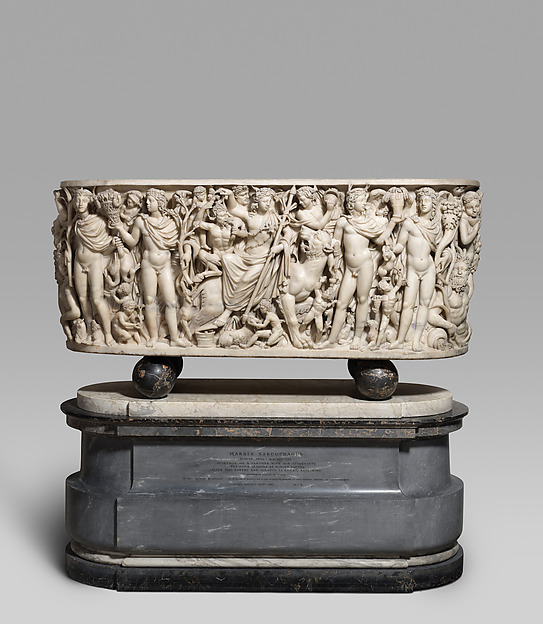
It is a box for a corpse. The Met dates it to roughly 260 to 270 CE, and that date is the most interesting thing about it.
The Decade It Was Made Was the Worst Rome Ever Had
Museum labels file this under Late Imperial, Gallienic, which sounds neutral. It means the reign of Gallienus, and the 260s were not a neutral decade.
In 260 the emperor Valerian was captured alive by Shapur I of Persia at Edessa. No Roman emperor had ever been taken prisoner by a foreign power, and he died in captivity. His son Gallienus inherited an empire that immediately started shedding pieces. Postumus set up a breakaway Gallic state covering Gaul, Britain, and Spain, with its own senate and its own emperors, and it held for fourteen years. In the east, Palmyra went from Roman client to independent power. The silver coinage had been debased so thoroughly that the antoninianus was essentially a bronze coin with a wash on it. A plague had been running through the population for years.
That is the world in which somebody in Rome commissioned this. A carving job of this complexity, with forty figures in deep undercut relief, represents an enormous quantity of skilled labour and a workshop operating at full capacity. Wealth was still there. So were the craftsmen and the marble supply and the client who wanted Dionysian triumph and the cycle of the Seasons wrapped around his remains.
The Seasons are the point, really. They are the argument the object is making: time turns over, winter comes back round to spring, death is a passage rather than a stop. That is a reassuring thing to spend money on when the currency is collapsing and the emperor is a prisoner in Persia.
The Back Was Never Finished
Turn it around and the illusion drops. The rear face is rough, unworked, plainly never meant to be seen. The sarcophagus was made to stand against the wall of a tomb chamber, presenting one decorated face and two decorated ends to whoever came in.
Roman funerary sculpture is full of this. The object is not a sculpture in the round but a stage set with a body inside, built for a fixed viewing position in a room that no longer exists. Every judgement we make about it in a museum gallery, where you can circle it freely under even lighting, is a judgement its maker did not design for.
The lid is gone too. Everything else has survived close to intact since it came out of the ground in the eighteenth century, which for a Roman sarcophagus is remarkable luck.
An English Duke Wrote on the Unfinished Back in 1733
That rough rear face carries an inscription, and it is not Roman. It records the sarcophagus being installed at Badminton House in Gloucestershire, seat of the Dukes of Beaufort, in 1733.
This is the Grand Tour working exactly as designed. British aristocrats went to Italy, bought antiquities from dealers and excavators, shipped them home, and arranged them in purpose-built rooms as proof of taste and classical education. A third-century Roman coffin crossed the Channel and became a furnishing in an English country house, where it stayed for more than two centuries and picked up the name it still carries. The Badminton Sarcophagus is named after a village in Gloucestershire.
The Met bought it in 1955 through the Joseph Pulitzer Bequest, and it stands in Gallery 162.
So the object has three lives stacked on top of each other. A wealthy Roman commissioned it as the empire fractured. A duke bought it as a trophy and signed the back. An American museum acquired it as an exhibit. The man it was carved for has no name in any of this, and there is no record of who he was or where in Rome his tomb chamber stood.
Forty figures, and the one person the whole thing was for is missing.