The Boscoreale Bedroom at the Met May Be Named for the Wrong Roman
Vesuvius buried the villa at Boscoreale in 79 CE, about a kilometre north of Pompeii on the mountain’s lower slopes. By then the room was already old. Its walls had been painted around 50 to 40 BCE, while Caesar was still alive and the Republic still formally existed, so what the eruption sealed was a century-old bedroom whose occupants had chosen not to redecorate.
You can walk into that bedroom today, in Gallery 165 of the Metropolitan Museum of Art in New York.
It is a cubiculum, small, with a narrow antechamber opening into an alcove where the bed stood. Painted Corinthian pilasters rise in each of the four corners and carry a painted architrave, so the walls pretend to be a frame holding up the ceiling. Past that frame, the painter dissolved the room. The side walls give you colonnaded buildings stacked at different depths, terraces pushing forward into the space, courtyards shut off behind jewelled red columns, a monumental gateway with a temple standing visible through the opening. The rear wall abandons architecture for rock: a trellised arbour above, a grotto below with a fountain running in it, a small figure of Hekate at the base.
None of this is a view. There was no window here, no real landscape on the far side of the plaster. The painter was given four solid walls in a windowless sleeping cell and instructed to make them stop being walls.
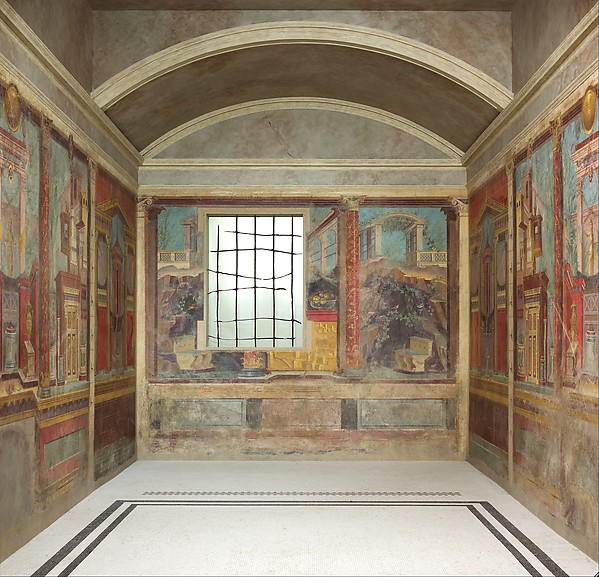
The Grammar Came Off the Stage
Art historians file this under Second Style, the phase running roughly from 80 to 20 BCE, when wealthy Romans wanted rooms that argued against their own dimensions. The earlier First Style had imitated expensive masonry, painting plaster to look like cut marble blocks. Second Style went further. It kept a shallow architectural frame at the front, then opened everything behind it into invented depth.
The vocabulary almost certainly came from the theatre. Hellenistic stagecraft had a practice called skenographia, the painting of architectural backdrops in receding perspective onto the scene building behind the actors. A Greek audience watching a tragedy sat in front of exactly this kind of illusion: gateways, temple fronts, colonnades stacked to suggest a city that was not there. The Boscoreale painter took a technique built for public performance and used it on a private bedroom wall, which tells you something about how a Roman of this class wanted to experience his own house.
Whoever he was.
Two Men, Two Pieces of Bronze
The villa carries the name of Publius Fannius Synistor because a bronze seal with that name on it surfaced during the excavation. Convenient, and museums have used it ever since. Other bronze tablets came out of the same site reading L. HER. FLO, which expands to Lucius Herennius Florus, and some scholars think Herennius Florus was the actual proprietor while Fannius Synistor was a resident or a member of the household.
The argument has never fully closed. Both men appear to have been at the villa in the early first century CE, which creates a second problem nobody advertises on the wall label: the paintings predate both of them by a hundred years. Neither commissioned this room. Whoever chose these walls, argued about the price, and decided that a windowless bedroom should look like a stage set, that person is anonymous.
It Survives Because Someone Cut It Off the Wall
In 1900 the site was dug privately, on private land, with no state archaeology involved. The frescoes were sawn from the walls in sections. The villa was partly dismantled and then reburied, and the panels went to auction.
They scattered. The Met bought this bedroom in 1903 through the Rogers Fund and reassembled it as a room, which is why New York has the most complete surviving interior from the villa. The Louvre took First Style walls from the same building. Further fragments ended up in Naples, Amsterdam, Brussels, and Mariemont. No institution holds the villa. Several hold pieces of it, catalogued separately, described in different languages, reconstructed according to different assumptions about what went where.
The Boscoreale Treasure left by a similar route. That hoard of silver tableware and gold coins came out of a neighbouring villa in 1895, was moved quietly out of Italy, and was sold in France. It is in the Louvre.
There is a version of this story where the 1900 dig is simply looting with better paperwork, and it is not a difficult version to argue. There is also the fact that the room is standing, lit, and open to anyone who walks into Gallery 165, which is more than can be said for most of what remains buried under Boscoreale.
Both things are true at once.