A Freed Slave in Augustan Rome Paid to Have His Wrinkles Carved in Marble
The piece is small, about nine and a half inches high, and it is obviously a fragment. A man’s head and shoulders, carved in marble in the late first century BCE, broken out of something considerably larger. The Met’s curators identify what that something was: a funerary relief, the kind set into the outside wall of a family tomb, and they think the man was almost certainly a freedman.
His face is not flattered. The flesh sits heavy around the mouth, the brow is creased, the whole head has the blunt hard-worn quality that art historians call verism. He paid for that. Somebody in Rome, a generation or two out of slavery, commissioned a portrait and specifically did not ask to be made handsome.
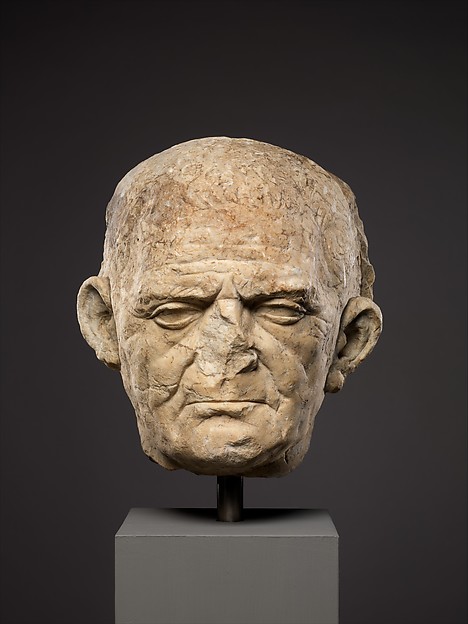
The Wrinkles Were an Argument
Roman aristocrats of the late Republic had spent two centuries using the veristic style to advertise seniority. Deep lines and a sagging jaw signalled decades of office-holding and campaigning, the accumulated credit that made a man worth listening to in the Senate. It was the visual language of people who had been in charge since anyone could remember.
Which is exactly why a freedman would want it. A former slave could not claim ancestors, because legally he had not had any that counted, and Roman families displayed their lineage through wax masks of officeholding forebears kept in the atrium. He had no atrium full of consuls. What he could do was borrow the register. Commissioning a portrait in the idiom of the senatorial class was a claim staked in the most durable material available, made by someone whose own body had recently been another man’s property.
There is a timing detail worth sitting with. This head dates to the Augustan period, roughly the same decades when the emperor was having himself carved permanently young and smooth, abandoning verism entirely. So at the exact moment the most powerful man in Rome dropped the old style, people at the bottom of the citizen order were picking it up. The prestige idiom had been vacated, and somebody moved in.
The Tombs Were Built to Be Read From the Road
These reliefs were not interior decoration. Roman law kept burials outside the city walls, so the major roads leading out of Rome were lined with tombs, and tomb facades competed for the attention of anyone walking past. The standard format set the portrait busts into a rectangular opening, so the dead appear to be leaning out of a window and looking at the traveller on the road.
Family groups are common. A husband and wife, sometimes with a child, sometimes with the couple’s hands joined in the gesture Romans used for a lawful marriage. That gesture carries weight in this context, because enslaved people could not legally marry at all. A freed couple displaying it on a public monument was making a point about status, not sentiment.
The inscriptions underneath usually carried the full name formula, which for a freedman included the name of the man who had owned him. The relationship was not hidden. It was part of the credential, because being freed by a Roman citizen was what made you one.
A child shown in these groups was often born after manumission, which made them freeborn from the start, outranking both parents. The reliefs are family portraits, and they are also documentation of a status jump happening inside a single generation.
Somebody Cut Him Out
What survives at the Met is one bust, on its own, separated from whoever stood beside him. The Museum bought it in 1917 through the Rogers Fund, and the record does not say when or by whom it was detached.
It hardly needs saying that a single portrait head is far easier to sell than a slab of tomb facade with three people on it. Fragments like this one circulated widely through the nineteenth and early twentieth-century antiquities trade, and a great many Roman reliefs were reduced to their most marketable parts somewhere along the way. Whether that happened here, or centuries earlier when the tomb was robbed out for building stone, is not recoverable.
What it means in practice is that we have the man and not his family. His wife, if she was carved next to him, is gone. So is the inscription that would have given him a name, and the name of the person who freed him.
He got the permanent monument he paid for. He just did not get to keep the part that said who he was.